


How to Care for Leather and Suede Loafers
Reading time 14 min • 2705 words
A good pair of loafers is not a seasonal purchase. It is an investment in a particular standard of dress, and like any serious investment it requires attention. The man who buys quality and neglects it ends up worse off than the man who never bought quality at all: cracked vamps, collapsed counters, nap that has been ground flat and cannot be revived.
Leather and suede are living materials. Both come from the same cowhide; the difference is that suede is buffed from the inner split of the hide, giving it that characteristic matte, velvety texture, while smooth leather is finished on the grain side. Each surface has distinct needs, distinct vulnerabilities, and a distinct set of tools required to maintain it properly.
What follows is a straightforward, practical guide. No mysticism, no expensive proprietary kits required. The right technique, the right products, and a small amount of consistent effort will keep a pair of well-made loafers looking distinguished for a decade or longer.
Key takeaways
- Brush suede in one direction with a dedicated brass or nylon bristle brush after every wear to lift the nap and prevent dirt from setting.
- Condition smooth leather loafers every four to six weeks with a cream conditioner, not a wax polish, to keep the hide supple without cracking.
- Apply a fluorocarbon-based waterproofing spray to both suede and leather before the first wear, and reapply every six to eight weeks.
- Insert cedar shoe trees immediately after removing loafers to absorb moisture and hold the shape of the last.
- Never dry wet leather or suede with direct heat. Stuff with newspaper and allow to air dry at room temperature.
In this guide
Understanding What You Are Working With
Before you reach for a brush or a conditioner, it helps to understand the material in your hands. Smooth leather loafers, such as the Florence Black Suede Genuine Leather Cowhide Shoes or the classic Milano Brown Loafers Genuine Leather Classic, use full-grain or corrected-grain cowhide on the outer surface. This grain layer is dense, relatively resistant to abrasion, and responds well to creams and waxes that replenish natural oils lost through wear and exposure.
Suede, by contrast, exposes the fibrous underside of the hide. Those short, raised fibres, called the nap, give suede its softness and its visual depth, but they also trap dust, absorb water rapidly, and mat down under pressure. A pair of Mykonos Navy Blue Slip-On Suede Loafers in a rich indigo nap will look entirely different after a week of neglect versus a week of proper brushing.
If you want a deeper look at how the two materials compare in terms of durability and occasion suitability, the article Suede vs Leather Loafers: Which Should You Choose? covers that ground well. For now, the practical point is this: treat them differently, because they are different.
Expert insightWhen buying new loafers, check whether the upper uses full-grain or suede before deciding on your care kit. The wrong product on the wrong surface, such as a wax polish applied to suede, can permanently alter the texture and appearance.

Daily and Post-Wear Habits That Make the Difference
Most shoe damage is incremental and invisible until it is not. The habits you build around everyday wear determine whether a loafer holds its form for two years or twelve.
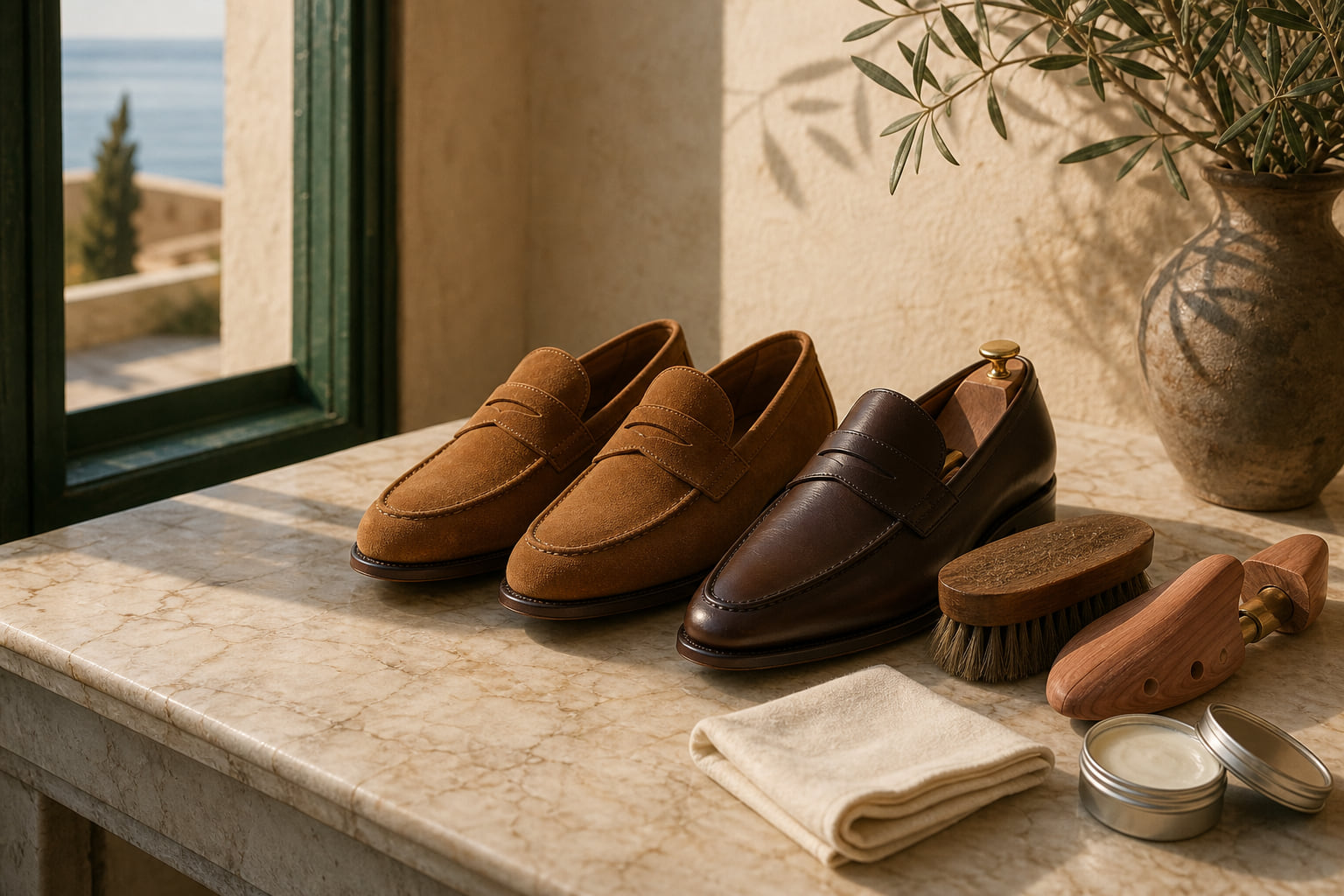
Cedar shoe trees are non-negotiable. Insert them immediately after removing the shoes, while the leather is still warm and slightly pliable from body heat. A split-toe cedar tree absorbs moisture from the interior lining, counteracts the natural tendency of the vamp to crease forward, and holds the heel counter in its proper shape. Plastic shoe trees do not absorb moisture and are largely cosmetic.
Brushing suede after every wear takes thirty seconds and prevents the majority of suede problems. Use a dedicated suede brush with brass or soft nylon bristles. Brush in one consistent direction to realign the nap fibres. If there is any surface dust or fine grit, brush it away before it works deeper into the fibres. For smooth leather, a quick wipe with a dry or very slightly damp cotton cloth removes surface dust that would otherwise act as a mild abrasive over time.
Rotation matters more than most men acknowledge. Wearing the same pair on consecutive days does not allow the interior lining to dry fully. Moisture from perspiration degrades the insole and the leather from the inside out. A minimum of two pairs in rotation, ideally three, extends the life of each pair considerably. The loafers old money style collection offers enough range to build that rotation without repetition.
Expert insightA split-toe cedar shoe tree, rather than a solid or two-piece plastic version, provides the most accurate tension across the vamp and toe box, which is where creasing concentrates on a loafer's slip-on construction.

Cleaning Leather Loafers: Step by Step
Smooth leather responds to a consistent cleaning and conditioning cycle. Do this every four to six weeks under normal wear, or after any exposure to rain, mud, or salt.
Step 1: Remove surface dirt. Use a horsehair brush or a clean cotton cloth to remove any loose dust and dried mud. Do not use water at this stage.
Step 2: Apply a leather cleaner. A mild pH-neutral leather cleaner applied with a soft cloth lifts embedded grime from the grain without stripping the natural oils. Work in small circular motions. Avoid saddle soap on fine dress leather, as it can be overly alkaline and dry out the hide over time.
Step 3: Condition. This is the most important step and the most skipped. A quality leather conditioner (a cream, not a wax) replaces the oils that cleaning and wear remove. According to the Leather Conservation Centre, untreated leather loses flexibility as oils evaporate, leading to cracking along stress lines at the toe box and the flex point. Apply conditioner sparingly with a cloth, work it in, and let it absorb for ten to fifteen minutes.
Step 4: Polish if desired. A wax-based shoe cream in the appropriate colour restores depth of colour and provides a modest water-resistant barrier. Buff with a horsehair brush for shine. The Paris Vintage Brown Loafers Handmade Genuine Leather develop a particularly rich patina with regular cream polishing, as the hand-burnished toe responds well to layered wax.
Step 5: Protect. Finish with a light application of a waterproofing spray formulated for smooth leather.
Expert insightAlways test any conditioner or polish on the inner heel lining before applying it to the visible upper. Some creams darken leather noticeably, which may be desirable on tan leathers but unwanted on lighter shades like apricot or sand.

Cleaning Suede Loafers: The Correct Technique
Suede requires a completely separate toolkit and a different mindset. The goal is to lift and realign fibres, not to saturate or scrub them.
For dry dirt and dust: Use a dedicated suede brush with brass bristles for light work, or a crepe rubber eraser block for scuffs and localised marks. Brush in one direction. For stubborn scuffs, rub the crepe block gently in a back-and-forth motion directly on the mark, then brush the nap back into alignment.
For wet stains: Counterintuitive as it sounds, the best immediate response to a liquid spill on suede is to blot, not rub, with a clean absorbent cloth, then allow the shoe to dry completely at room temperature before brushing. Rubbing a wet suede stain pushes the liquid deeper into the fibres and spreads the mark. Once dry, the residue is often removable with the crepe eraser.
For oil-based stains: Apply a small amount of cornstarch or talcum powder directly to the stain, leave it overnight to absorb the oil, then brush away. Repeat if necessary. Commercial suede degreaser sprays work on the same principle.
Restoring crushed or matted nap: Hold the shoe over steam from a kettle for a few seconds at a safe distance, then immediately brush the nap upright with the suede brush. This technique is particularly effective on the toe box and heel areas where the nap tends to flatten first. The Mediterranean Suede Slip-On Loafers in their brushed finish respond exceptionally well to this method.
For a broader discussion of how suede holds up against smooth leather across different occasions and seasons, the article Stealth Wealth Footwear: Why Suede Loafers Rule 2026 is worth reading alongside this guide.

Waterproofing and Seasonal Protection
Waterproofing is preventive care, not emergency care. Apply it before the first wear on any new pair of leather or suede loafers, and reapply every six to eight weeks or after any thorough cleaning.
The correct product for both suede and smooth leather is a fluorocarbon-based waterproofing spray. It works by coating each fibre or grain pore with a water-repellent barrier without changing the texture or breathability of the material. Silicone sprays are cheaper but can leave a residue that darkens suede and clogs the grain of smooth leather over time. Avoid them on quality footwear.
Apply the spray in a well-ventilated space, holding the can approximately 20 to 25 cm from the shoe surface. Apply two light coats rather than one heavy one, allowing the first to dry for five minutes before the second. Pay particular attention to the seams, the toe box, and the area around the welt, where water tends to penetrate first.
Seasonal considerations: In summer, salt from perspiration and coastal environments is a more significant threat than rain. Salt crystals draw moisture out of leather and leave white tide marks. If you wear loafers such as the Mykonos Camel Slip-On Suede Loafers in warm coastal conditions, wipe down the exterior after each wear and condition more frequently, every three to four weeks rather than six.
In winter, road salt and grit are the primary concerns. Wipe shoes down immediately after exposure to salted pavements with a damp cloth, then dry and condition. Salt left on leather overnight begins to break down the surface fibres. The article on black vs brown loafers touches on how colour choice also affects visibility of seasonal salt marks, which is a practical consideration worth factoring into your rotation.

Storage, Repairs, and Knowing When to Resole
How you store loafers determines how quickly they deteriorate between wears. The basic rules are simple but frequently ignored.
Always store with cedar shoe trees inserted. If you are storing a pair for more than a week, wrap them loosely in a soft cotton dust bag, not plastic. Plastic traps humidity and encourages mould growth on both leather and suede. Keep shoes in a cool, dry location away from direct sunlight, which fades colour and dries out the grain.
Avoid stacking shoes directly on top of each other. The weight distorts the quarter and heel counter of the lower pair over time. Original shoe boxes with the cedar trees inserted are an adequate solution for medium-term storage.
Resoling: A well-constructed loafer, such as the Florence Light Brown Suede Genuine Leather Cowhide Shoes with a proper leather or rubber sole, can be resoled by a cobbler when the original sole wears through. This is almost always worth doing rather than replacing the shoe, provided the upper is in good condition. A full resole on a quality loafer typically costs a fraction of the shoe's original price and adds years to its life.
Heel tips: The small rubber or leather heel tip at the back of a loafer wears down faster than the rest of the sole. Replace it before it wears through to the heel stack itself. Once the stack is damaged, the repair becomes significantly more expensive. This is a five-minute job for any cobbler and costs very little.
For men building a considered shoe wardrobe, the man footwear collection offers a range of constructions worth understanding from a maintenance perspective. Different sole types, leather outsoles, rubber outsoles, and crepe, require slightly different care approaches, and knowing what is on your shoe before you visit a cobbler saves time and avoids miscommunication.
Permanent Style has written well on the value of resoling quality footwear and why a good cobbler relationship is as important as the original purchase, a perspective that aligns with how we think about footwear at Lovau.

| Care Task | Smooth Leather | Suede | Frequency | Tool Required |
|---|---|---|---|---|
| Daily maintenance | Wipe with dry cotton cloth | Brush nap in one direction | After every wear | Cotton cloth / suede brush |
| Deep cleaning | pH-neutral leather cleaner, circular motion | Crepe eraser block for scuffs, dry brush | Monthly or as needed | Leather cleaner / crepe block |
| Conditioning | Cream conditioner applied and buffed in | Not applicable, use renovating spray instead | Every 4 to 6 weeks | Conditioner cream / applicator cloth |
| Waterproofing | Fluorocarbon spray, 2 light coats | Fluorocarbon spray, 2 light coats | Before first wear, then every 6 to 8 weeks | Fluorocarbon waterproofing spray |
| Nap restoration | Not applicable | Steam and brush upright immediately | When nap is matted or crushed | Kettle steam / suede brush |
| Stain treatment | Conditioner after cleaning removes most marks | Cornstarch for oil, blot and dry for liquid | As needed | Cornstarch / absorbent cloth |
Frequently asked questions
Can I wear suede loafers in the rain?
A properly waterproofed suede loafer can handle light rain without permanent damage. Apply a fluorocarbon spray before the first wear and reapply regularly. If the shoes do get wet, blot them dry, stuff with newspaper, and allow them to air dry at room temperature before brushing the nap back into shape. Avoid wearing suede in heavy or prolonged rain regardless of waterproofing. For a comparison of how suede and leather handle different conditions, see Suede vs Leather Loafers: Which Should You Choose?
How often should I condition leather loafers?
Every four to six weeks under regular wear, and always after a thorough cleaning or exposure to wet conditions. In dry or hot climates, condition more frequently, every three to four weeks. The sign that leather needs conditioning is a slightly dull, tight surface feel or very fine surface cracks beginning to appear along the flex point at the toe box.
What is the best way to remove a watermark from suede?
Allow the shoe to dry completely first. Then use a crepe rubber eraser block to gently work the dried watermark, followed by brushing the nap back into alignment with a suede brush. For persistent marks, lightly dampen the entire upper with a very fine mist of clean water, which allows the whole surface to dry evenly and eliminates the tide line effect. Do not apply direct heat at any point.
Do I really need cedar shoe trees, or will any shoe tree work?
Cedar is genuinely better for two reasons: it actively absorbs moisture from the interior lining, and it releases a mild cedar oil that inhibits bacterial growth responsible for odour. Plastic trees provide shape support only and do nothing for moisture. For loafers in particular, where the slip-on construction means the vamp takes the full strain of entry and exit, a split-toe cedar tree that tensions the forefoot is the most effective option.
Leather and suede loafers are among the most versatile and long-lived shoes a man can own, provided they receive consistent, informed care. The habits are not complicated: brush after every wear, condition on a schedule, waterproof before exposure, and store properly. A pair that might otherwise look tired after two seasons will instead develop the kind of quiet, earned patina that cannot be faked or bought. If you are building your collection or considering your next pair, the best loafers for men in 2026 guide is a useful starting point for understanding which constructions and materials reward long-term investment.