


Why Heavyweight T-Shirts Drape Better Than Lightweight Ones
Reading time 14 min • 2818 words
Pick up two t-shirts from your wardrobe and hold them side by side. The one that feels substantial in the hand is almost certainly the one that looks better on your body. This is not coincidence. Fabric weight governs how cloth moves against the body, how it resists distortion under tension, and how cleanly it presents a silhouette. It is the difference between a garment that looks considered and one that simply looks worn.
Most men have never been told this. Retail markets cheap t-shirts on colour and cut, never on construction. The result is wardrobes full of thin, clinging, semi-transparent shirts that photograph badly and age quickly. Understanding fabric weight means you stop guessing and start choosing with confidence.
This guide explains the mechanics behind drape, what GSM actually means for fit, and how to identify a heavyweight t-shirt worth buying. Every recommendation here is specific, practical, and grounded in how cloth actually behaves.
Key takeaways
- Fabric weight, measured in grams per square metre (GSM), directly determines how a t-shirt falls and holds its shape on the body.
- Heavyweight t-shirts (180 GSM and above) resist clinging, recover their structure after washing, and project a cleaner silhouette.
- Lightweight t-shirts below 140 GSM are prone to transparency, static cling, and collar distortion within a few washes.
- For a refined, old-money look, choose a t-shirt with a tight knit construction and a weight between 180 and 220 GSM.
- Mercerized or lyocell-blended cotton adds drape and sheen to a heavyweight knit without sacrificing structure.
In this guide
- What GSM Means and Why It Matters for Fit
- The Mechanics of Drape: Why Weight Creates Shape
- Collar Integrity: The First Place a Cheap T-Shirt Fails
- Heavyweight Fabric and the Silhouette After Washing
- Pairing Heavyweight T-Shirts with Shirts and Outerwear
- How to Identify a Genuine Heavyweight T-Shirt When Shopping
- Frequently asked questions
What GSM Means and Why It Matters for Fit
GSM stands for grams per square metre, the standard measure of fabric weight used across the textile industry. A single square metre of the fabric is weighed, and that number tells you how dense and substantial the cloth is. For knitted jersey fabric, which is what t-shirts are made from, the typical range runs from around 100 GSM at the lightest end to 280 GSM at the heaviest.
A t-shirt below 140 GSM is considered lightweight. These fabrics are thin, often translucent in direct light, and have very little structural memory. They cling to whatever is beneath them, including the contours of the torso, which is rarely flattering. They also stretch out quickly at the collar and underarms, because there is simply not enough fibre per unit area to resist repeated tension.
Anything from 180 GSM upward behaves differently. The denser weave of fibres creates a fabric that holds a flat plane against the body rather than collapsing into it. When you move, a heavyweight knit shifts with you and returns to its resting position. A lightweight knit shifts and stays shifted. That difference, in practical terms, is the difference between a t-shirt that looks intentional and one that looks like an afterthought.
The sweet spot for a refined everyday t-shirt is 180 to 220 GSM. Below that, you sacrifice structure. Above 240 GSM, the fabric starts to feel more like a sweatshirt and loses the clean, smooth surface that reads as smart.
Expert insightWhen assessing a t-shirt in a shop, fold the fabric over your finger and hold it to a light source. If you can read text through the cloth, it is too light to drape well. A well-constructed heavyweight knit will be fully opaque even in strong sunlight.

The Mechanics of Drape: Why Weight Creates Shape
Drape, in technical textile terms, is the ability of a fabric to fall into smooth folds under its own weight. A heavier fabric has more mass per unit area, which means gravity acts on it more effectively. The cloth falls away from the body cleanly rather than resting against it and picking up every contour.
This is why a well-made heavyweight t-shirt looks almost architectural on the torso. The fabric hangs from the shoulders, skims the chest and abdomen, and falls straight at the hem. A lightweight t-shirt, lacking that mass, is pulled toward the body by static and friction. It maps the stomach, sticks to the lower back when you sit, and bunches at the waist when you tuck or half-tuck.
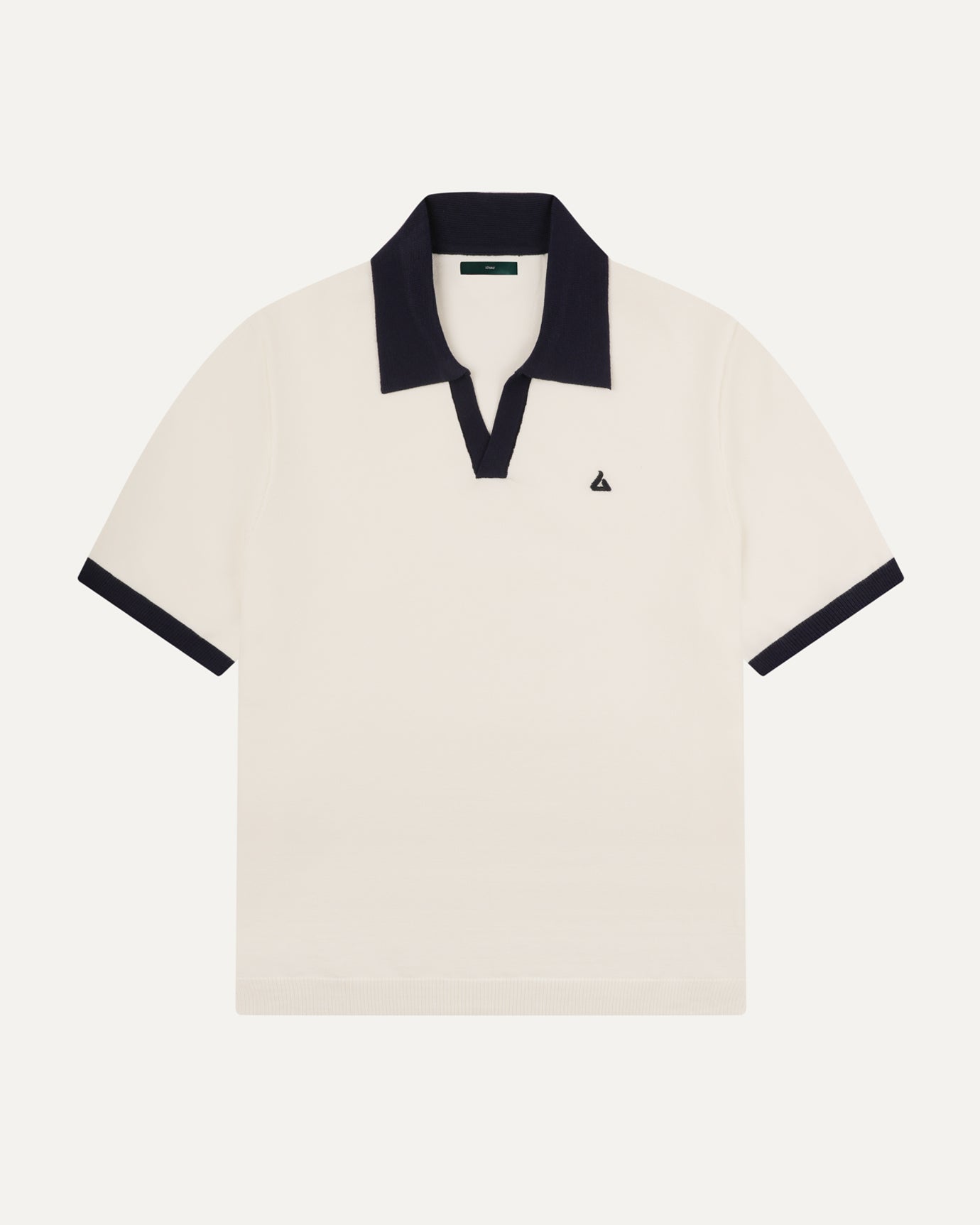
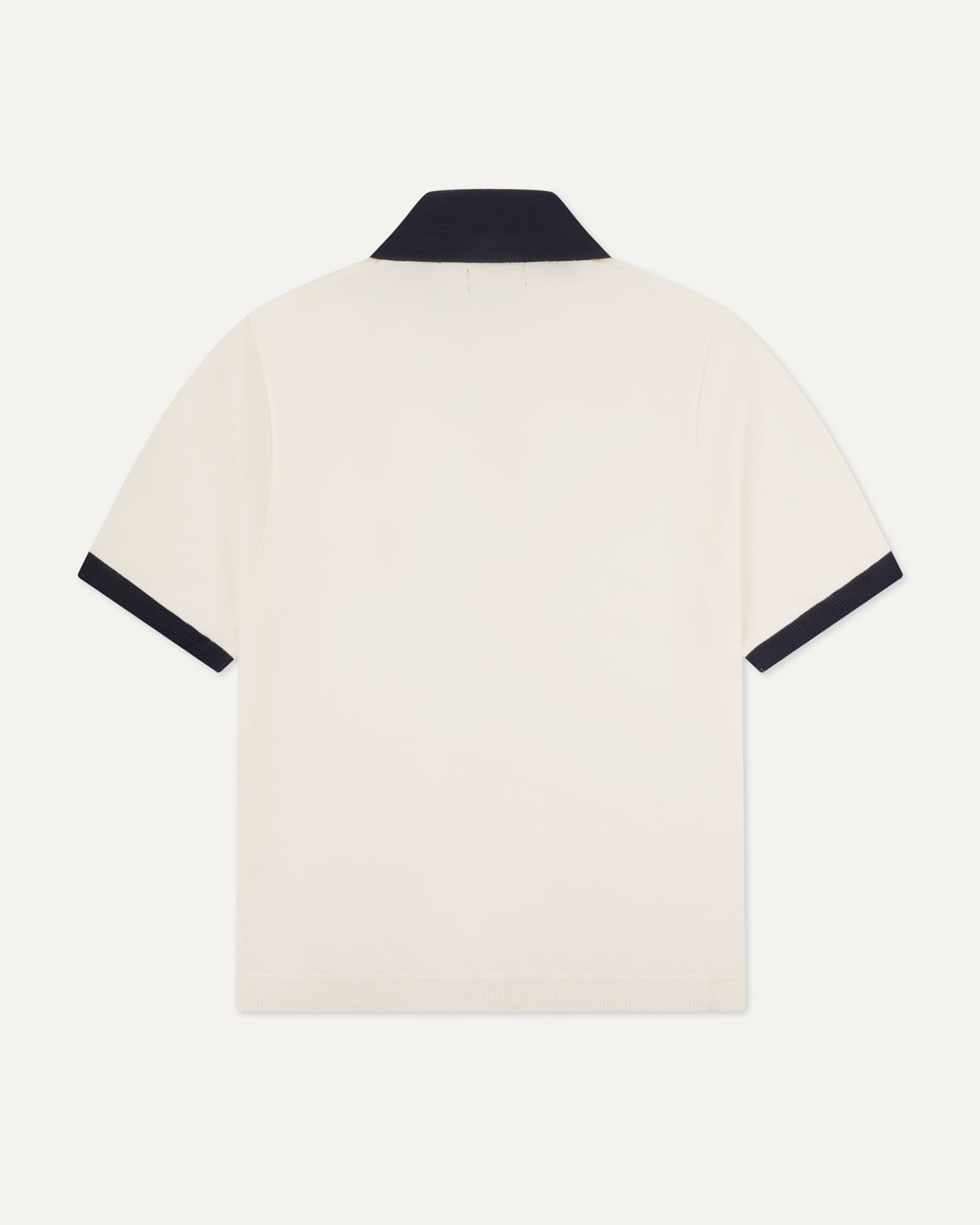
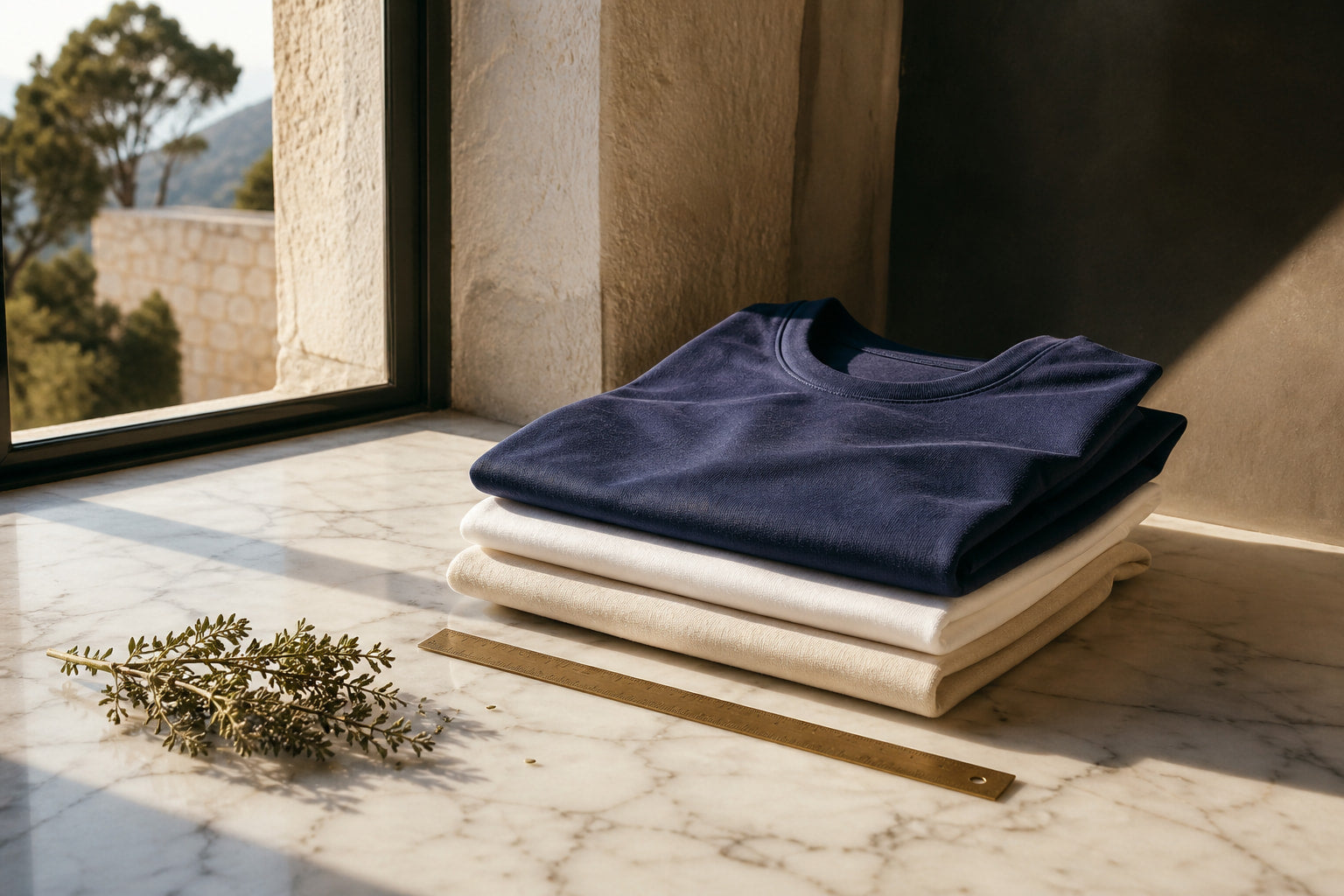
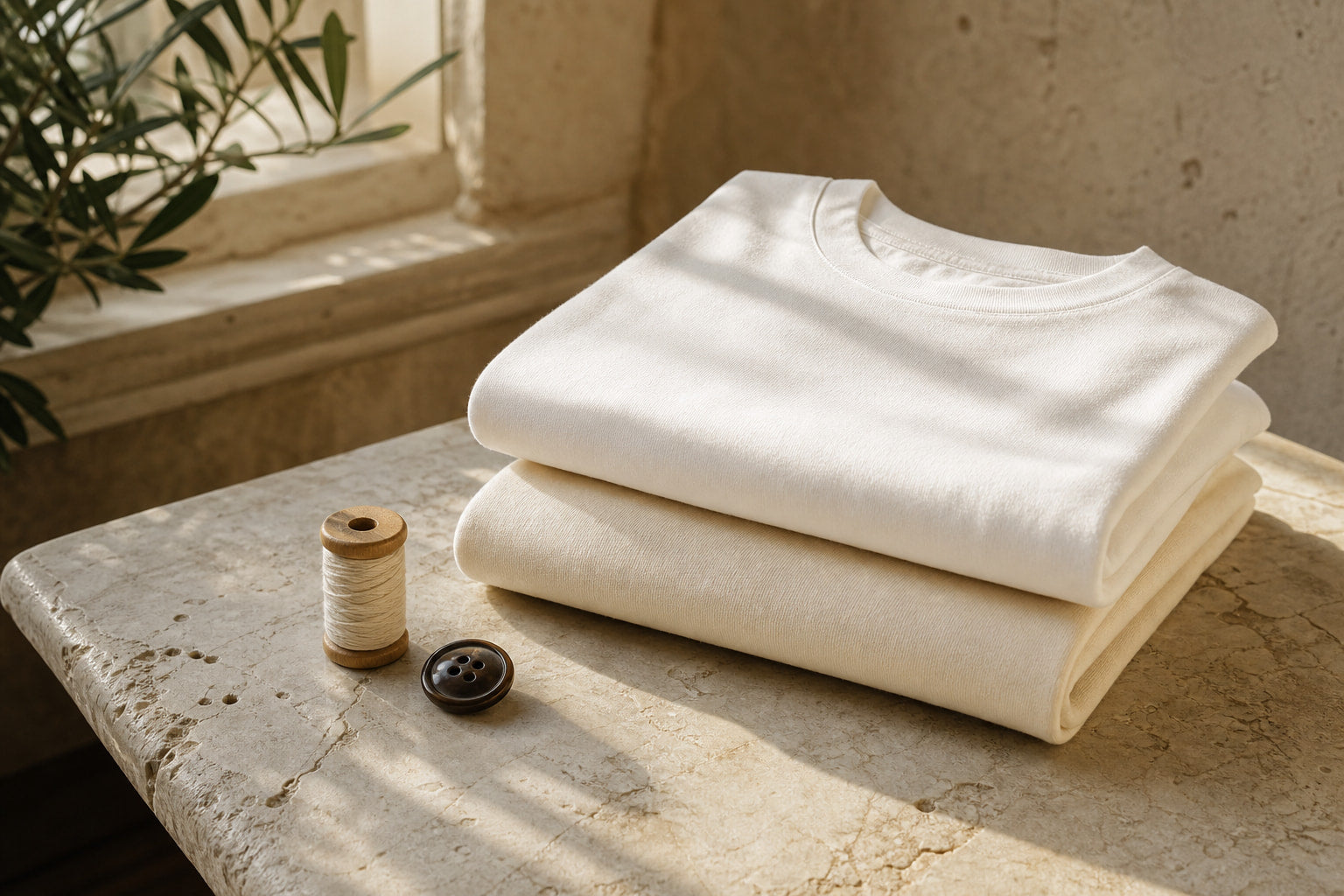
Knit construction also plays a role. A tighter knit, meaning more stitches per centimetre, creates a denser surface that resists pilling and deformation. When you combine a tight knit with a higher GSM, you get a t-shirt that behaves more like a fine woven fabric in terms of its cleanliness of line. The Belle Montecarlo T-Shirt Off-White is a strong example of this: the mercerized cotton construction adds a subtle sheen and increases the yarn's density, so the fabric drapes with unusual smoothness for a knitted garment.
Fibre content also modulates drape. Pure cotton at high GSM drapes well but can feel stiff. Adding a small percentage of lyocell, a cellulose-based fibre derived from wood pulp, increases the fabric's natural drape coefficient without reducing its weight. The result is a t-shirt that falls more fluidly while retaining the mass needed to hold its shape.
Expert insightMercerized cotton, treated under tension with sodium hydroxide, has a permanently smoother fibre surface. This increases light reflection and reduces friction between the fabric and the skin, which is a significant reason why mercerized heavyweight t-shirts cling less than untreated equivalents of the same weight.

Collar Integrity: The First Place a Cheap T-Shirt Fails
The collar is the highest-visibility part of a t-shirt. It sits at eye level, frames the face, and is the first detail anyone reads when they look at you. It is also the first structural element to fail on a lightweight t-shirt.
A crew or V-neck collar on a thin jersey is held in shape primarily by the rib trim around the opening. When the base fabric is too light, that trim has nothing substantial to anchor to. After a handful of washes and the repeated stretching of pulling the shirt over your head, the collar distorts, waves, and loses its geometry. On a man wearing a t-shirt alone, a collapsed collar reads immediately as low quality.
On a heavyweight knit, the collar trim is anchored to a fabric that has genuine body. The rib and the base cloth work together to hold the opening in a clean, consistent shape. This matters especially if you wear a t-shirt under a blazer or an open linen shirt, where the collar is visible at the neckline. A neat, firm collar contributes to the overall composition of the outfit. A wavy one undermines everything above it.
For men who want a t-shirt that reads as intentional rather than incidental, collar construction is not a minor detail. It is one of the clearest signals of quality. If you are building a wardrobe around refined basics, pairing a heavyweight t-shirt with a well-cut old money shirt over the top is a reliable formula that works from a morning coffee to a casual lunch.
Expert insightA double-needle stitched hem and a reinforced side seam are reliable indicators that the manufacturer expected the fabric to be washed frequently and under tension. These details are more common on heavyweight constructions because the base cloth justifies the additional finishing cost.

Heavyweight Fabric and the Silhouette After Washing
A t-shirt does not only need to drape well on the day you buy it. It needs to drape well after fifty washes. This is where fabric weight becomes a genuine long-term investment rather than a short-term vanity.
Lightweight jersey shrinks and distorts unevenly in the wash. The fibres, having less structural mass to hold them in place, contract in an irregular pattern. The result is a t-shirt that was once a size medium and is now something closer to a fitted small, with a collar that tilts to one side and a hem that sits higher at the front than the back. This is not a laundering failure. It is a fabric failure.
Heavyweight cotton, particularly when pre-shrunk or sanforized during production, maintains its dimensions far more reliably. The denser fibre structure means individual yarns have less room to migrate during the heat and agitation of a wash cycle. You can read more about the correct way to care for premium cotton in our guide on steaming and pressing premium cotton shirts, and many of those principles apply equally to heavyweight t-shirts.
For graphic or printed t-shirts, fabric weight matters for an additional reason: the print substrate. A heavier base fabric provides a more stable surface for screen printing or garment dyeing. The Ayrton Senna Donington Park T-shirt and its off-white variant are built on a heavyweight base precisely because the graphic requires a flat, stable canvas to read cleanly. On a lightweight jersey, the same print would stretch and distort with every wear.
When shopping, look for pre-shrunk or sanforized on the label. If neither is stated, wash the shirt once before forming any opinion about its fit.

Pairing Heavyweight T-Shirts with Shirts and Outerwear
A heavyweight t-shirt earns its place in a refined wardrobe partly through what it does on its own, and partly through how well it layers. Because a heavier fabric holds its shape under compression, it does not bunch or bunch visibly under a shirt or jacket the way a thin t-shirt does.
Worn under an open linen shirt, a heavyweight white or off-white t-shirt creates a clean base layer that contributes positively to the overall composition. The High-End Double Mercerized Lyocell Cotton Long Sleeve T-Shirt is designed with this layering function in mind. The mercerized lyocell blend gives it a smooth, flat surface that does not add bulk under a shirt, while the weight ensures it does not ride up or twist when you move.
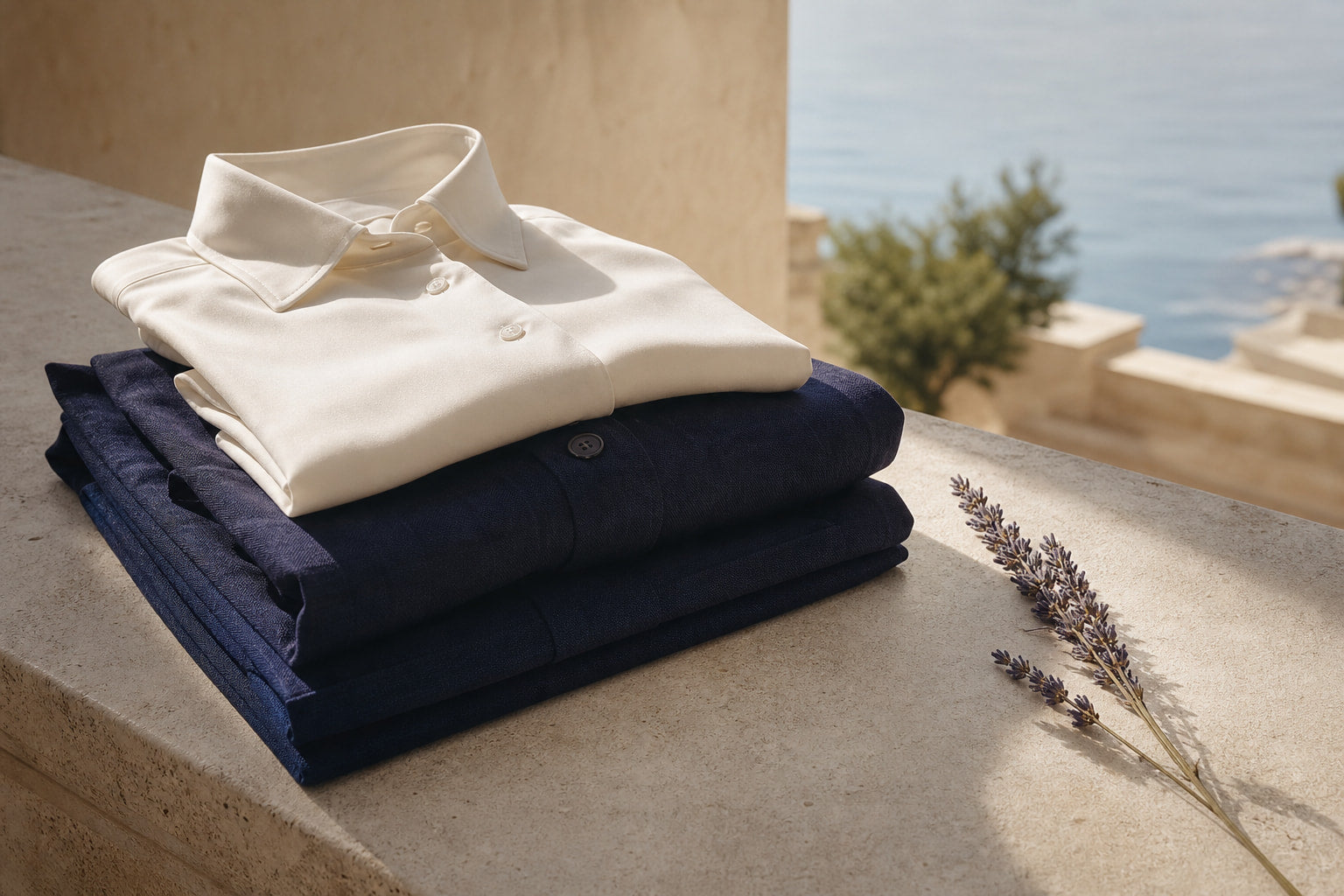
For pairing, a fine linen overshirt works particularly well. The High Count Fine Light Blue Linen Shirt worn open over a white heavyweight t-shirt is a combination that functions across a wide range of summer occasions, from a harbour-side lunch to a gallery opening. The linen provides structure at the shoulder and a defined collar line, while the t-shirt underneath keeps the look grounded and relaxed.
If you are interested in how collar geometry interacts with neckline choices, our article on the best collar shapes for different face profiles covers the principles that apply whether you are wearing a shirt alone or over a crew-neck base layer.
For colder months, a heavyweight t-shirt under a tailored sport coat is a legitimate option, provided the t-shirt has a clean, firm collar and is free of any visible stretch or distortion. The weight of the fabric is what makes this combination work. A thin t-shirt under a blazer reads as underdressed. A heavyweight one reads as intentional.

How to Identify a Genuine Heavyweight T-Shirt When Shopping
Weight is rarely stated on a swing tag in a retail context. Brands that use premium heavyweight fabric tend to mention it in product descriptions, often citing GSM. If that information is absent, there are physical tests you can perform.
The fold test: Fold the fabric over two fingers. A heavyweight knit will hold a soft ridge with some resistance. A lightweight knit will collapse flat immediately.
The stretch and return test: Pull the fabric gently across the grain, then release it. A well-constructed heavyweight jersey will snap back to its original dimensions quickly. A lightweight one will recover slowly or not fully.
The opacity test: Hold the fabric up to a bright light or window. A true heavyweight t-shirt will be fully opaque. Any visible light transmission through the body of the fabric indicates a weight below 160 GSM.
The seam test: Run your finger along the side seam and hem. Double-needle stitching, which appears as two parallel rows of thread, indicates a manufacturer who invested in construction. Single-needle stitching on a lightweight fabric is the most common indicator of a budget garment.
For printed t-shirts with graphic content, the East Hampton Yacht Club Esmerald Green T-shirt demonstrates what a quality print on a heavyweight base looks like in practice. The colour saturation is higher, the edges of the graphic are sharper, and the print does not crack or peel at the fold lines because the base fabric provides stable, consistent support.
Finally, price is a useful but imperfect signal. A well-constructed heavyweight t-shirt in a quality cotton or lyocell blend will rarely be priced below eighty euros. If a t-shirt costs twenty euros, the fabric weight has almost certainly been reduced to protect the margin. You can browse the full range of men's t-shirts and refined basics to see how weight and construction translate into real garments.

| Weight Range | GSM | Drape Quality | Transparency Risk | Collar Durability | Best Use |
|---|---|---|---|---|---|
| Ultra-lightweight | 100 to 140 GSM | Poor, clings to body | High, often see-through | Low, distorts quickly | Gym, activewear only |
| Lightweight | 140 to 160 GSM | Fair, some cling | Moderate in direct light | Moderate, fades with washing | Casual wear, layering filler |
| Mid-weight | 160 to 180 GSM | Good, holds basic shape | Low in most conditions | Good with quality rib trim | Everyday casual, travel |
| Heavyweight | 180 to 220 GSM | Excellent, clean silhouette | None | Excellent, retains geometry | Smart casual, refined basics |
| Ultra-heavyweight | 220 to 280 GSM | Very structured, minimal movement | None | Excellent | Outerwear-adjacent, cold months |
Frequently asked questions
What is the ideal GSM for a men's everyday t-shirt?
For a t-shirt that drapes cleanly, holds its collar shape, and survives regular washing without distortion, the ideal range is 180 to 220 GSM. Below 180 GSM, the fabric lacks the mass to fall away from the body cleanly. Above 220 GSM, the garment starts to feel more like a sweatshirt than a refined knit. For a premium option in this range, the Belle Montecarlo T-Shirt White is built on a mercerized cotton base that sits squarely in the optimal weight band.
Does a heavier t-shirt feel too hot in summer?
Not necessarily. Fabric weight alone does not determine breathability. A heavyweight open-knit or a heavyweight lyocell-cotton blend can breathe very well because the fibre structure allows air circulation even at higher GSM. What makes a summer t-shirt uncomfortable is a tight, non-breathable weave, not the weight itself. A well-constructed heavyweight cotton jersey at 190 GSM will often feel more comfortable in heat than a thin synthetic blend at 130 GSM, because natural fibres wick moisture more effectively.
Can I wear a heavyweight t-shirt under a dress shirt?
Yes, and a heavyweight t-shirt is actually better suited to this purpose than a lightweight one. Because the fabric holds its shape under compression, it does not bunch or ripple under a shirt. The key is to choose a t-shirt with a low crew neck or a V-neck that sits well below the shirt collar. A t-shirt with a firm, flat collar that sits cleanly at the neckline will not create visible bulk. For guidance on how collar geometry interacts with layering, the article on tailoring a button-down shirt to accentuate your frame covers the relevant principles.
How do I stop a heavyweight t-shirt from shrinking in the wash?
Wash on a cold or 30-degree cycle and air dry flat or on a hanger rather than in a tumble dryer. The tumble dryer is responsible for the majority of shrinkage in cotton knitwear, regardless of weight. If the t-shirt is labelled pre-shrunk or sanforized, it has already been treated to minimise further shrinkage, but heat from a dryer will still cause some fibre contraction over time. Heavyweight t-shirts are more resistant to shrinkage than lightweight ones because the denser fibre structure has less room to contract, but no cotton knit is entirely immune to heat.
Fabric weight is not a technical detail for specialists. It is the single most practical variable in how a t-shirt looks on a man's body, how long it retains that look, and how confidently it functions across the range of occasions a well-dressed man encounters. Choosing a heavyweight construction is not about spending more for its own sake. It is about understanding that a garment with genuine structural mass will drape cleanly, hold its collar, survive the wash, and layer properly under a shirt or jacket. If you are building a wardrobe of refined basics that will serve you across seasons, start by browsing the full men's old money collection and pay close attention to fabric weight before anything else.