


How to Tailor a Button-Down Shirt to Accentuate Your Frame
Reading time 15 min • 2905 words
A button-down shirt that fits correctly is not a luxury reserved for those with a perfectly proportioned frame. It is the result of knowing which measurements matter, which alterations are worth paying for, and how the fabric itself contributes to the final silhouette. Most shirts sold off the rack are cut to accommodate a broad range of bodies, which means they fit almost no one precisely.
This guide is written for anyone who has bought a shirt they loved in theory but never quite wore in practice. The collar gaped, the chest pulled, the body billowed. These are not signs that the shirt was wrong for you. They are signs that three or four specific adjustments were needed, and that a competent tailor could have made them in under an hour.
The principles here apply to men and women equally, with notes where the approach differs. Whether you are working with a fine linen shirt, a structured cotton poplin, or a soft lyocell blend, the logic of fit remains the same.
Key takeaways
- The shoulder seam is the one measurement that cannot be fixed cheaply; always buy to fit the shoulders first.
- Taking in the side seams is the most affordable and transformative alteration a tailor can make to any shirt.
- Sleeve length should allow roughly half an inch of cuff to show below a jacket sleeve; too long is just as problematic as too short.
- Fabric weight and weave affect how a shirt drapes; high-count linen holds its shape and flatters more consistently than loose-weave cotton.
- For women, a simple dart added at the back waist converts a boxy shirt into a shape that follows the body without clinging.
In this guide
- Start at the Shoulders: The Measurement That Cannot Be Faked
- The Body: Side Seams, Darts, and the Question of Taper
- Collar and Cuffs: The Details That Determine the Impression
- Fabric Weight and Weave: How the Material Shapes the Fit
- Women's Fit Specifics: Adapting a Button-Down to the Female Frame
- When to Tailor Versus When to Simply Buy Better
- Frequently asked questions
Start at the Shoulders: The Measurement That Cannot Be Faked
Before any other measurement is considered, the shoulder seam must sit correctly. This is the one point of a shirt that is extremely difficult and expensive to alter after the fact, because moving a shoulder seam requires dismantling the sleeve entirely and resetting it. Most tailors will advise against it unless the shirt is worth the cost.
The shoulder seam should sit precisely at the edge of your shoulder, where the arm begins to drop away. If it falls even two centimetres onto the upper arm, the sleeve will pull forward and restrict movement. If it sits too far inward, the chest and upper back will feel tight regardless of how much fabric is in the body.
Buy to fit the shoulders first. Everything else, the body, the sleeves, the collar, can be adjusted. The shoulders cannot, not practically.
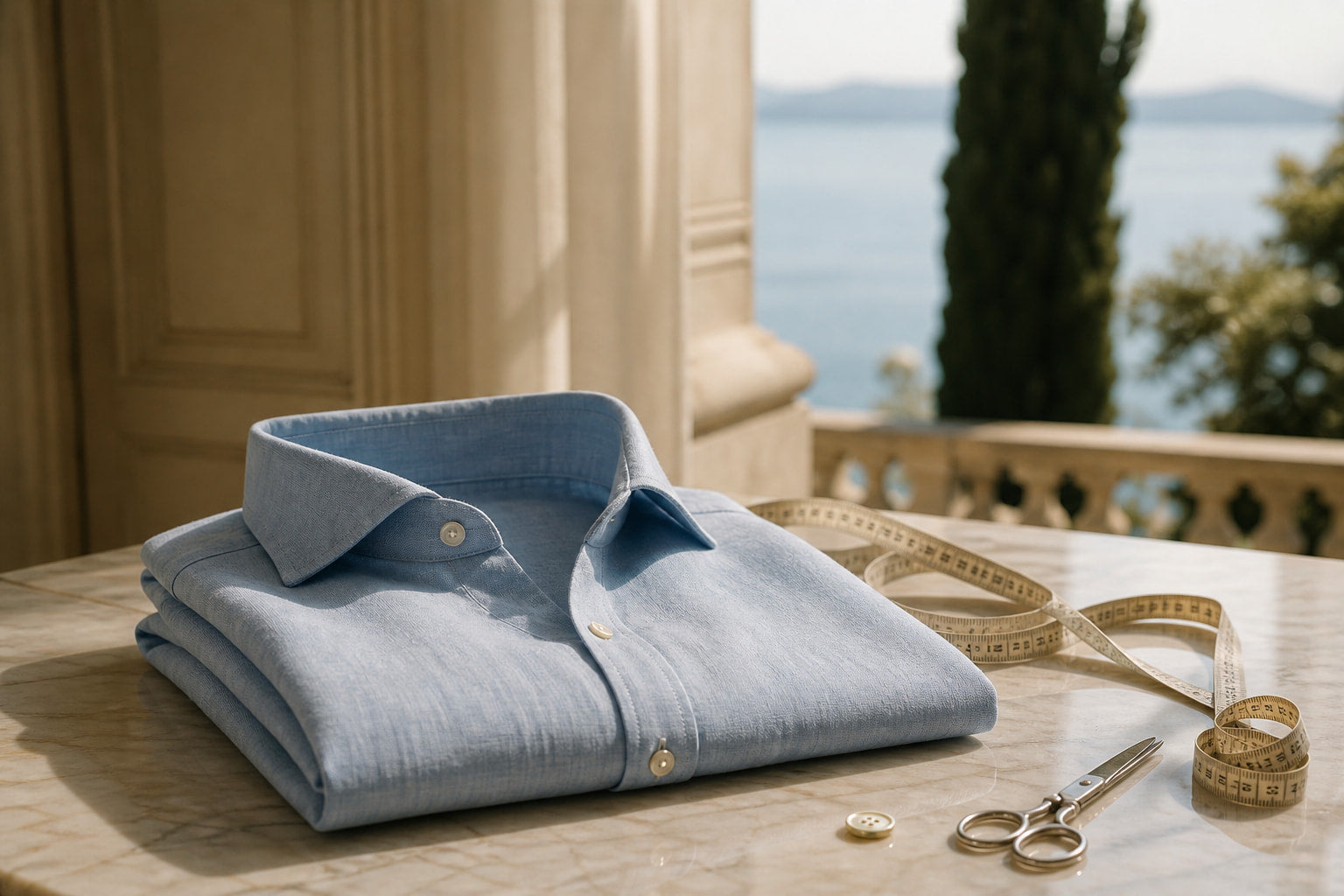
For men with broader shoulders and a narrower waist, this principle often means buying a size up in the shoulders and having the body taken in significantly. For women with narrow or sloped shoulders, it may mean sizing down in the shoulders and having the body let out slightly, or choosing a shirt cut with a more considered shoulder line from the start. Our high-count fine light blue linen shirt is cut with a shoulder line that runs slightly more structured than most casual linen shirts, which makes this calibration easier.
Expert insightIf you are between sizes and the shoulder fits on one but the chest is too tight on the other, always take the larger size. A tailor can take in a body in twenty minutes. No one can add shoulder width that was never there.

The Body: Side Seams, Darts, and the Question of Taper
Once the shoulders are confirmed, the body of the shirt is where most of the tailoring work happens. The goal is not a tight fit. It is a controlled fit: enough room to move comfortably, but no excess fabric pooling at the sides or creating a sail-like silhouette when tucked in.
For men, the most common and cost-effective alteration is taking in the side seams. A tailor will pin the shirt on your body, mark the new seam line from just below the armhole to the hem, and sew it in. This single change transforms a boxy shirt into one that follows the natural taper from chest to waist. Expect to pay between fifteen and thirty euros for this alteration at most European ateliers.
For women, the addition of back darts is the equivalent adjustment. A dart sewn into the back panel, typically two of them running vertically from the shoulder blade down toward the waist, pulls the fabric in at the back and creates a shape that suggests the waist without compressing it. This is especially effective on structured shirts like our old money retro style shirt, where the fabric has enough body to hold a dart cleanly.
If you wear your shirt untucked, the hem length also matters. A shirt hem that falls below the hip pocket level on trousers tends to read as unfinished. Most tailors can shorten a shirt hem in the same appointment as the side seam work, and the cost is usually minimal.
- Slim frame: Keep one to two centimetres of ease at the side seam. Too much taper can make a slim torso appear narrower than intended.
- Athletic frame (broad shoulders, narrower waist): A more aggressive taper at the side seams, from chest to waist, will follow the natural shape without adding bulk.
- Fuller torso: Focus on removing excess fabric at the back rather than pulling both side seams in equally. This avoids creating horizontal pull lines across the chest.
Expert insightAsk your tailor to leave a small seam allowance when taking in the sides. If you gain or lose weight, the shirt can be let out or taken in again without starting from scratch.

Collar and Cuffs: The Details That Determine the Impression
The collar is the closest element to the face, and its fit is read immediately. A collar that is too large will gap at the front button, creating a loose, unresolved look. A collar that is too tight will cause the fabric to pucker and will be genuinely uncomfortable by mid-afternoon.
The correct collar fit allows you to slide two fingers comfortably beneath the collar band when it is buttoned. No more, no less. If you are buying a shirt specifically to wear with a tie or cravat, you may want the collar slightly more generous, as the knot will take up some of that space. If the shirt is primarily worn open-collared, a closer fit is appropriate.
Collars can be altered, but it is a more specialized job than side seams. Reducing a collar band by more than one centimetre risks distorting the front placket. It is better to get this right at the point of purchase. Look for shirts where the collar construction is clean and the band sits flat against the neck without rolling.
Cuffs follow a simpler rule. The sleeve should end at the base of the thumb, where the wrist meets the hand. When worn under a jacket, roughly twelve millimetres of cuff should remain visible below the jacket sleeve. Sleeve shortening is a standard alteration and one of the least expensive. It does require that the tailor match the cuff style when reattaching it, so bring the shirt, not just a measurement.
For women wearing a shirt as a standalone piece rather than under a jacket, the sleeve length is more flexible. A shirt with a slightly longer sleeve that can be rolled once or twice at the cuff, as with our retro vintage lyocell linen shirt, offers more versatility and avoids the need for precise shortening.
Expert insightWhen shortening sleeves, always ask the tailor to reattach the original cuff rather than cut a new one. The original cuff has already been broken in to your wrist shape and the buttonhole is already sized.

Fabric Weight and Weave: How the Material Shapes the Fit
Fit is not only a matter of measurement. The fabric itself determines how a shirt drapes, where it clings, and how well it holds any alteration made to it. This is a point that is often overlooked in fit guides, but it is central to how a finished shirt actually behaves on the body.
High-count linen is one of the most forgiving fabrics for tailoring. A high thread count in linen, typically above 100 threads per centimetre in the weave, produces a fabric that is smooth, slightly structured, and resistant to the creasing and bunching that makes cheaper linen look careless after an hour of wear. It also holds a dart or a side seam alteration cleanly, without puckering. Our high-count fine black linen shirt and high-count navy blue fine linen shirt are both made from this quality of linen, which is why they photograph and wear so differently from standard linen shirts at a lower price point.
According to the Textile Institute's definition of woven fabric construction, thread count directly affects surface smoothness and drape, both of which influence how a garment sits on the body.
Lyocell blends are softer and have a natural drape that follows the body without the structure of linen. They are more flattering on frames that do not want a shirt to stand away from the body, but they are also less forgiving of poor tailoring because the softness makes any puckered seam more visible.
Cotton poplin sits between the two: smooth, slightly crisp, holds a clean line. It is the classic choice for a dress shirt and the easiest to tailor because the fabric does not shift or stretch during the alteration process.
- Linen (high count): structured, breathable, holds shape, best for Mediterranean and warm-weather wear
- Lyocell: soft drape, fluid, flattering on most frames, less suited to stiff collar construction
- Cotton poplin: crisp, versatile, ideal for dress occasions, easiest to alter

Women's Fit Specifics: Adapting a Button-Down to the Female Frame
The standard button-down shirt was historically cut for the male torso, and many women's shirts on the market today still follow proportions that do not account for the difference between hip and waist, or the curve from shoulder to bust. Understanding where these gaps typically appear makes it much easier to address them.
The most common fit issue for women wearing a button-down is pulling across the bust. This happens when the shirt fits at the shoulder and waist but lacks fabric across the fullest part of the chest. The solution is not to buy a larger size, which will then be too large everywhere else. The solution is to have a tailor add a small amount of ease at the bust, either by releasing the side seam slightly in that zone alone, or by choosing a shirt that already accounts for this in its cut.
The marbella square collar linen shirt is cut with a slightly more generous front panel, which makes it a practical starting point for women who find standard shirt cuts restrictive across the chest.
For women who prefer a more defined waist, the tie-front or belted shirt achieves the same visual effect as a dart without any tailoring at all. A shirt tied at the front hem, or cinched with a narrow belt, creates a waist where the fabric would otherwise hang straight. This works particularly well with shirts in softer fabrics like lyocell or fine linen.
The woman shirt collection at Lovau includes several styles already cut with the female frame in mind, reducing the number of alterations needed from the outset. For women who want the look of a classic shirt with less structural tailoring, the blouse shirt embroidery blue offers a softer construction that moves more naturally without requiring darts or side seam work.

When to Tailor Versus When to Simply Buy Better
Tailoring is not always the answer. There is a point at which the cost of alterations approaches or exceeds the cost of buying a shirt that fits better from the start. Understanding that threshold saves money and frustration.
As a general rule, if a shirt requires more than three separate alterations, it is worth asking whether the base garment is the right starting point. Three alterations on a forty-euro shirt can easily cost more than the shirt itself. Three alterations on a well-made linen shirt at a higher price point are a sound investment, because the base fabric and construction justify the additional spend.
The shirts in Lovau's linen range, including the high-count fine green linen shirt and the san marino limited edition linen shirt, are cut with proportions informed by European tailoring standards, which means the gap between the shirt as purchased and the shirt as it should fit is typically smaller than with mass-market alternatives. In many cases, a single alteration, usually the side seams, is sufficient.
For men who want a reference point on what constitutes a well-fitted shirt before visiting a tailor, the guide published by Permanent Style on shirt fit is one of the clearest and most specific available. It covers the same points raised here with additional photographic reference.
The most important habit is simply to try on shirts before buying them whenever possible, and to stand in the shirt as you would actually wear it, with your arms at your sides, raised, and crossed in front of you. A shirt that restricts movement in any of those positions will not be worn, regardless of how well it is tailored afterward.

| Alteration | What It Fixes | Difficulty for Tailor | Typical Cost (EUR) | Worth It If |
|---|---|---|---|---|
| Side seam tapering | Boxy or oversized body silhouette | Low | 15 to 30 | Shirt fits at shoulders and collar |
| Back darts (women) | Lack of waist definition, excess back fabric | Low to medium | 20 to 35 | Shirt is a structured fabric like linen or poplin |
| Sleeve shortening | Sleeves too long, cuff falls past wrist | Low | 15 to 25 | Cuff style is worth preserving |
| Collar band reduction | Collar too large, gaps at front button | Medium to high | 25 to 45 | Shirt fits everywhere else and collar gap is under 2 cm |
| Shoulder seam reset | Shoulder seam falls onto upper arm | Very high | 60 to 120+ | Almost never; buy a different size instead |
| Hem shortening | Shirt tail too long for untucked wear | Low | 10 to 20 | Shirt is worn untucked regularly |
Frequently asked questions
How much does it typically cost to have a shirt tailored?
The most common alterations, taking in the side seams and shortening the sleeves, each cost between fifteen and thirty euros at most independent tailors in Europe. A full set of adjustments including side seams, sleeve shortening, and hem work will typically run between forty and seventy euros. More complex work like collar reduction or shoulder adjustment costs significantly more and is rarely worth pursuing unless the shirt is of exceptional quality.
Can a linen shirt be tailored as easily as a cotton shirt?
Yes, provided the linen is of sufficient quality. High-count linen, such as the fabric used in the high-count fine white linen shirt, holds a seam cleanly and does not fray or shift the way loosely woven linen does. A skilled tailor will have no difficulty altering a well-made linen shirt. Lower-quality linen with an open weave can be more problematic, as the fabric may pucker around new seams.
What is the single most important fit point to get right when buying a shirt off the rack?
The shoulder seam. It must sit precisely at the edge of the shoulder where the arm begins to drop. This is the one point that cannot be corrected affordably after purchase. Buy to fit the shoulders and have everything else adjusted by a tailor.
How do women get a better fit from a standard button-down shirt?
The two most effective adjustments are back darts, which create waist definition without tightening the front, and a slight release of the side seam at the bust if the fabric pulls across the chest. Choosing shirts already cut for the female frame, like those in the woman shirt collection, reduces the amount of tailoring needed from the start.
A button-down shirt that fits your frame is not the product of luck or a perfect body. It is the product of understanding four or five specific measurements, knowing which alterations are straightforward and which are not worth attempting, and choosing a base garment with enough quality in the fabric and construction to reward the investment. Start with the shoulders, work inward, and do not overlook what the fabric itself contributes to the final result. If you are ready to start with a shirt worth tailoring, the high-count fine navy blue linen shirt is a strong foundation: cut with considered proportions, made from a fabric that holds every alteration cleanly, and built to last long enough to justify the care.