


How a Linen Suit Should Actually Fit: The Golden Rules
Reading time 13 min • 2555 words
A linen suit occupies a specific and honourable place in a man's wardrobe. It is not a substitute for a wool suit worn reluctantly in heat. It is its own category, with its own proportions, its own behaviour on the body, and its own rules. Getting those rules right is the difference between looking studied and looking sloppy.
Linen, as a cloth, is honest. It does not drape with the liquid forgiveness of a fine wool. It holds a shape, creases where it wants to, and shows every excess of fabric as a fold or a pucker. That honesty is precisely what makes fit so consequential. A well-fitted linen suit reads as composed and confident. A poorly fitted one looks like you borrowed it.
This guide addresses every fit point on the jacket and the trousers, explains why each one matters specifically with linen, and tells you what can be fixed by a tailor and what cannot. Read it before you buy, and again before you alter.
Key takeaways
- The shoulder seam is the single most important fit point on a linen jacket; it cannot be altered without major cost.
- Linen relaxes and stretches slightly with wear, so a jacket that feels slightly firm across the chest at purchase will settle into a clean fit.
- Linen trousers should break once at the shoe, never pool; a half-break or no-break reads as the more considered choice.
- The jacket's middle button, when fastened, should not pull or create an X-shape across the torso.
- Sleeve length on a linen jacket should show roughly one centimetre of shirt cuff, which gives the whole outfit a finished, deliberate quality.
In this guide
The Jacket Shoulder: Where Everything Begins
The shoulder seam is the structural foundation of any tailored jacket, and with linen it is even more critical than with softer cloths. Linen has very little stretch across the grain, which means a jacket shoulder that sits even a centimetre too wide will not fall into place with wear. It will simply hang.
The seam where the sleeve is joined to the jacket body should sit exactly at the edge of your shoulder, at the bony prominence where your arm begins. Not five millimetres over it, not five millimetres short of it. Precisely there.
Signs the shoulder is too wide: the sleeve head droops, there is a horizontal crease running from the collar toward the arm, and the whole jacket looks borrowed. Signs it is too narrow: you feel resistance when you reach forward, the back of the jacket rides up, and the collar may pull away from your shirt collar.
A shoulder alteration on a structured jacket is among the most expensive and technically demanding changes a tailor can make. Treat the shoulder as a non-negotiable. If it does not fit in the shop, move on.
Expert insightLinen canvas, used in traditionally constructed jackets, does not ease and relax the way a soft fused interlining does. When you try on a linen jacket in a shop, stand naturally and raise both arms to chest height. If you feel significant resistance in the back or the collar lifts, the shoulder is too small. No amount of wearing-in will fix that.
Chest and Torso: The Button Test and the Silhouette
Once the shoulder fits, the chest and torso are the next points of attention. With a two-button jacket, button the middle button and stand naturally. You are looking for a clean, flat front with no pulling across the chest and no X-shaped tension lines radiating from the button. If those lines appear, the chest is too small.
At the same time, the fabric should not billow away from your torso at the sides. A linen jacket that is too large in the body creates a boxy, shapeless silhouette that reads as careless rather than relaxed. There is a meaningful difference between a relaxed, structured fit and a jacket that simply has too much cloth.
Linen does relax slightly across the chest with wear and warmth. A jacket that feels marginally firm across the pectorals at the point of purchase will typically settle into a comfortable fit after a few hours. This is not an excuse to buy a jacket that is genuinely too small, but it is worth knowing that linen does not behave like a stiff cotton poplin.
The side seams, when you look at the jacket from behind, should run in a straight vertical line. If they bow outward, the jacket is too tight. If they swing forward, it is too loose in the back.
Expert insightA single-breasted linen jacket with a suppressed waist, meaning a gentle inward curve at the sides, looks considerably more polished than a boxy cut. The suppression does not need to be dramatic. Even a modest shaping at the waist seam separates a considered garment from a shapeless one.
Sleeve Length and the Shirt Cuff
Sleeve length is a detail that most men overlook, but it is one of the most visible indicators of whether a suit has been properly fitted or simply purchased off the rack and left as-is.
The standard rule is that roughly one centimetre of shirt cuff should be visible below the jacket sleeve when your arms hang naturally at your sides. This applies equally to a linen suit worn in August in the South of France as it does to a wool suit worn in London in November. The proportion does not change with the season.
With linen, there is a particular reason to observe this rule carefully. Linen jackets are often worn with high-quality linen shirts, and those shirts frequently have a softer, less structured cuff than a formal dress shirt. That is entirely appropriate. The point is not to show a stiff white cuff; it is to show that the proportions of the jacket have been considered.
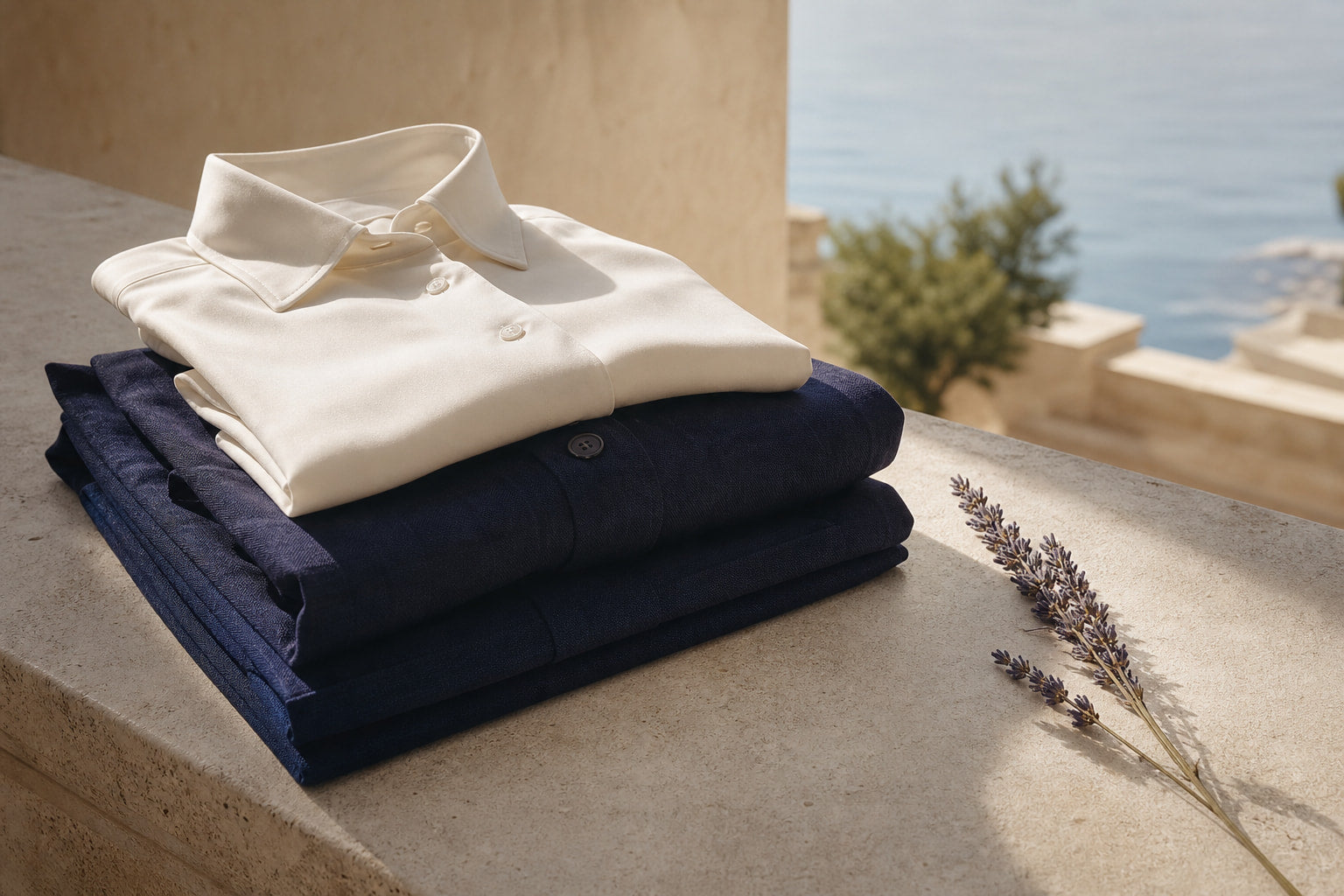
If you are wearing a high count fine white linen shirt beneath the jacket, the cuff will be clean and minimal, which works precisely because the shirt itself is refined. The same applies to a high count fine light blue linen shirt, where the contrast against a natural or cream linen jacket reads as quietly deliberate.
Sleeve length can be altered by a competent tailor in under an hour. It is one of the easiest and least expensive adjustments available to you. There is no reason to leave it wrong.
Expert insightIf you are wearing a linen jacket with a casual open-collar shirt, you can push the sleeve length very slightly longer, so just the edge of the shirt cuff is visible or barely visible. This reads as relaxed without becoming sloppy.

Linen Trousers: Break, Rise, and Width
The trouser is where many men make the most consequential fit errors with a linen suit. Linen trousers are not forgiving of excess cloth. Because the fabric creases readily, any surplus material in the thigh or seat will fold and crease in unflattering directions.
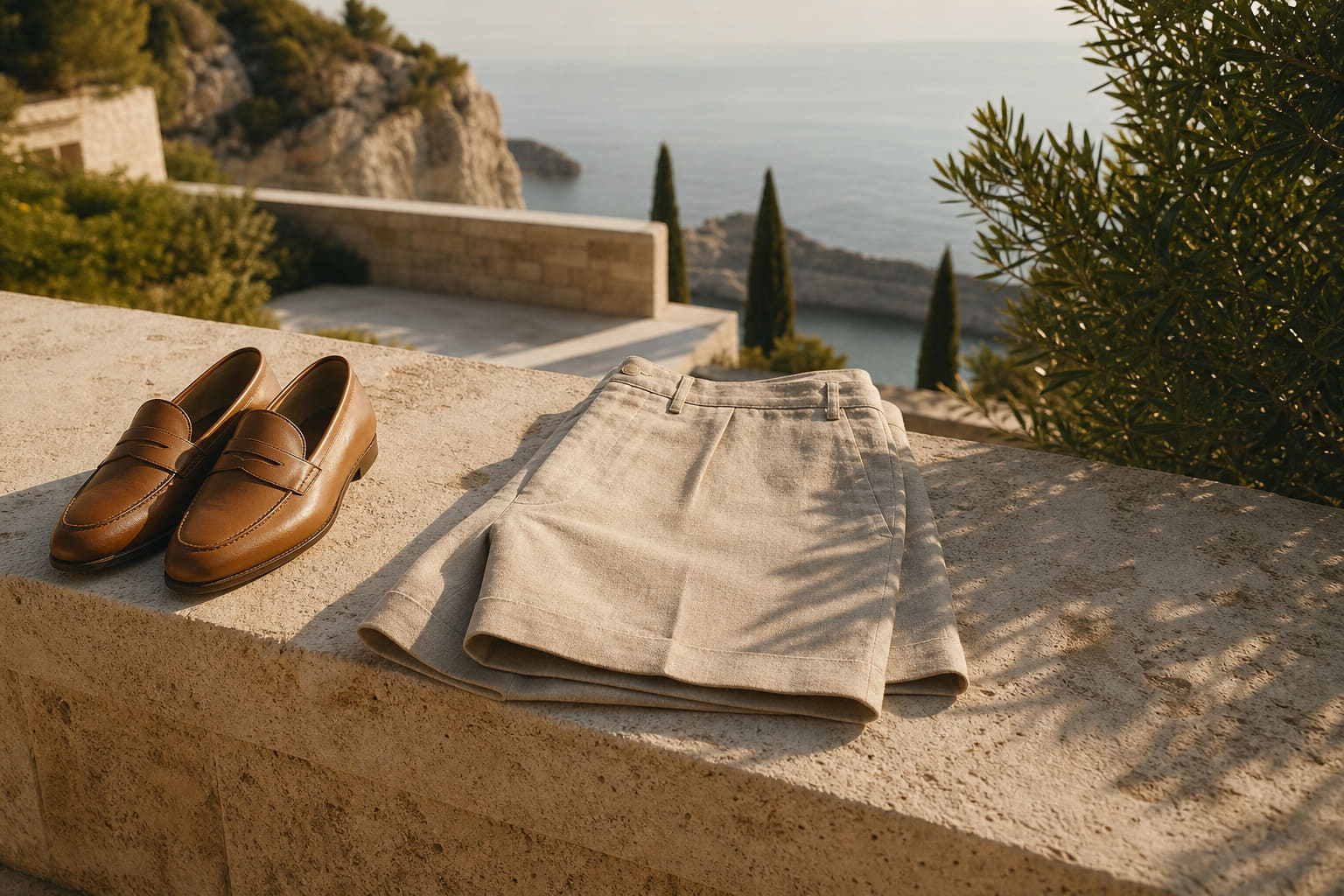
The break refers to how much the trouser hem rests on the top of the shoe. For a linen suit, the correct choice is a half-break, meaning the hem touches the shoe with just a small horizontal crease, or a clean no-break, where the hem sits just above the shoe entirely. A full break, where the trouser pools at the ankle, looks heavy and unfinished in linen. The cloth does not have the weight to carry it.
Rise is the distance from the crotch seam to the waistband. Linen suits in the Mediterranean tradition tend toward a mid to high rise, which sits at the natural waist and creates a longer, leaner line through the leg. A very low rise on linen trousers tends to shorten the torso visually and creates unwanted creasing across the seat.
The Paris Linen Trousers are cut with exactly this kind of clean, straight line in mind. For a slightly more relaxed approach that still reads as polished, the Marbella Linen Trousers offer a relaxed straight leg that suits both a tailored jacket and a linen shirt worn without a tie.
Width through the thigh and knee should allow you to walk and sit without the fabric pulling taut across the front of the leg. Linen, unlike stretch cotton, has no give. A trouser that is too slim through the thigh will distort with every step. At the same time, excessive width in the thigh creates fabric that bunches and creases randomly. A business cotton and linen blend trouser can also serve as a lighter-weight option when you want the structure of a tailored trouser without committing fully to a suit.

What to Wear Beneath the Jacket
A linen suit is not worn in isolation. The shirt beneath it, and the shoes below the trousers, are as much a part of the fit equation as the jacket itself. A shirt that is too voluminous will bunch visibly under the jacket. A shirt that is too slim will prevent you from buttoning the jacket comfortably.
For a linen suit, the shirt should be clean and relatively fitted through the body without being tight. The collar, whether a classic spread, a camp collar, or a more architectural design like the Marbella Square Collar Linen Shirt, should sit neatly inside or just at the jacket lapel without bunching.
A contemporary navy blue linen shirt worn open-collar under a natural linen jacket is one of the most quietly correct combinations available in warm-weather dressing. The tonal contrast is present but not loud. For evenings, a high count navy blue fine linen shirt with a finer weave reads more formal and holds its own under a jacket without adding visual noise.
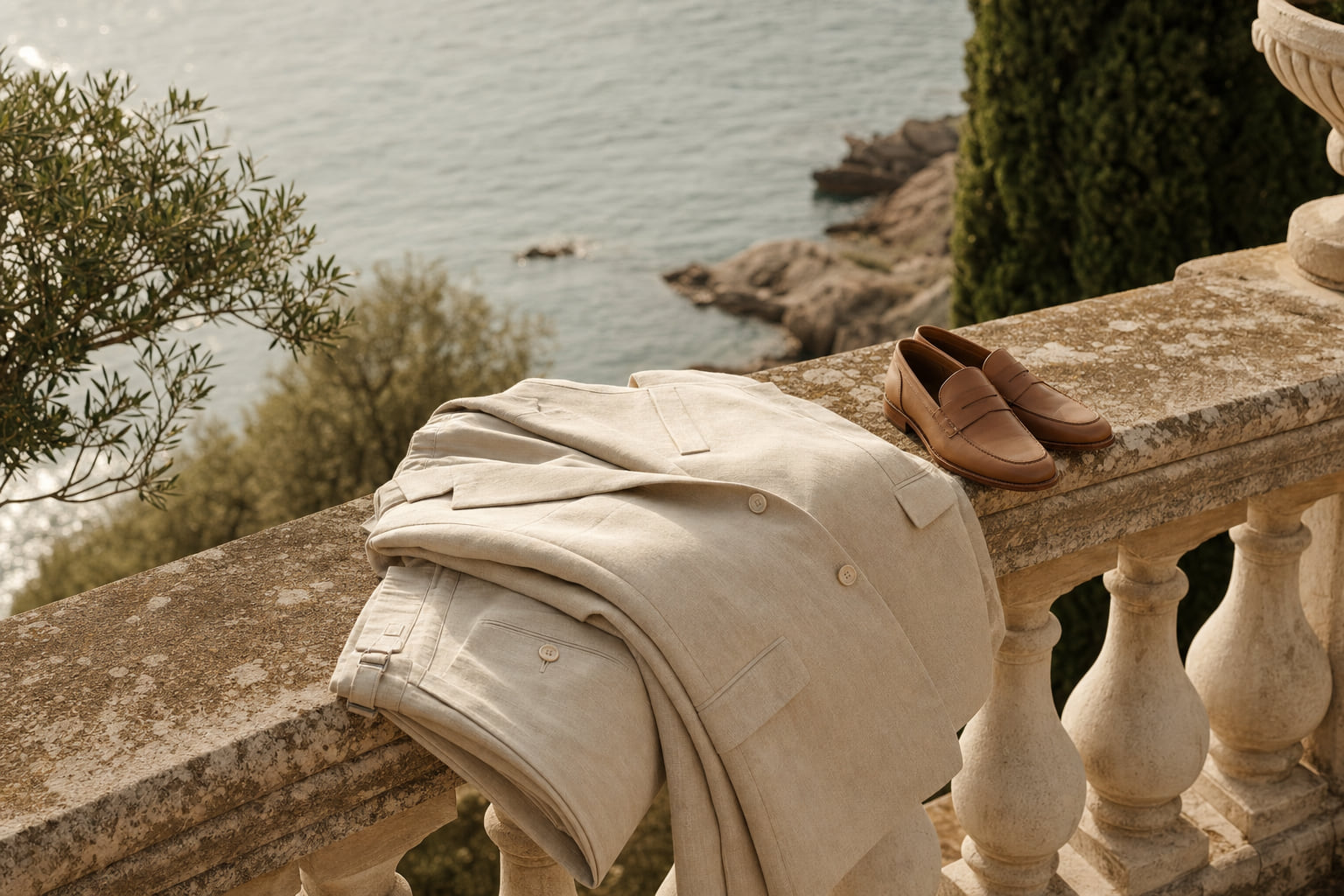
At the foot, the shoe choice completes the silhouette. A clean leather loafer is the most appropriate shoe for a linen suit in the European tradition. The Ibiza Linen Leather Loafers pair directly with the cloth through their linen upper detail, which creates a coherent material story from jacket to shoe. Alternatively, the Retro Linen Leather Loafers offer a slightly more vintage-inflected silhouette that suits a looser, more relaxed linen suit cut.
According to Permanent Style, the relationship between shoe and trouser hem is one of the most underappreciated proportional considerations in tailored dressing. A slim, clean loafer under a linen trouser with a no-break hem is a combination that rewards close attention.

Alterations: What Can Be Fixed and What Cannot
Understanding which fit problems are solvable and which are structural is practical knowledge that will save you money and frustration.
Alterations that are straightforward and inexpensive: sleeve length, trouser hem, taking in the trouser seat, suppressing the jacket waist slightly, taking in the jacket side seams.
Alterations that are complex and costly: shoulder width, chest width on a structured jacket, re-cutting the trouser rise, moving the collar.
Alterations that are essentially impossible without rebuilding the garment: adding width where there is no seam allowance, shortening a jacket body significantly without distorting the vent.
The practical conclusion is this: buy for the shoulder and the chest. Accept that the trouser hem, the sleeve length, and minor body adjustments are normal finishing steps. A tailor is not a sign that something went wrong. It is simply part of the process of wearing clothes well.
As Wikipedia notes on the history of bespoke tailoring, the tradition of fitting a garment to the specific body of its wearer has always involved multiple stages of adjustment. Off-the-rack buying followed by intelligent alteration is a reasonable contemporary version of that same principle.
If you are building a wardrobe around linen, the full linen shirts collection and the linen trousers collection offer a range of fits and cuts to assess before committing to alterations.

| Fit Point | What Correct Looks Like | Can a Tailor Fix It? | Consequence of Poor Fit |
|---|---|---|---|
| Jacket shoulder | Seam sits exactly at shoulder edge, no droop or pull | Rarely, and at high cost | Jacket looks borrowed, sleeve falls incorrectly |
| Jacket chest | No X-tension when buttoned, no billowing at sides | Yes, within limits of seam allowance | Jacket pulls open or looks boxy and shapeless |
| Jacket sleeve length | 1 cm of shirt cuff visible at rest | Yes, straightforward and inexpensive | Outfit looks unfinished or sleeves look too long |
| Trouser break | Half-break or no-break at the shoe | Yes, basic hem alteration | Full break looks heavy and dated in linen |
| Trouser rise | Mid to high rise at natural waist | Complex, involves re-cutting | Low rise shortens the leg line and creases badly at seat |
| Trouser thigh width | Walks without pulling, no diagonal creasing | Yes, taking in side seams | Random creasing across the front of the leg |
Frequently asked questions
Should a linen suit jacket be fitted or relaxed?
It should be fitted, not tight. The jacket should follow the shape of your torso without pulling across the chest or billowing at the sides. A relaxed fit in linen refers to the overall silhouette and the way the cloth behaves with movement, not to excess fabric. Think of it as structured ease rather than looseness.
How much should linen trousers be taken in?
Only as much as is needed to remove random diagonal creasing and allow a clean vertical fold down the front of the leg. Linen trousers should never be altered to a slim or skinny fit. The cloth does not have the stretch to accommodate that, and the result will be pulling and distortion with every step. A straight or gently tapered leg is the correct target.
Can I wear a linen suit jacket with non-matching trousers?
Yes, and it is often the more interesting choice. A linen jacket worn with Paris Linen Trousers in a contrasting neutral, or with tailored chinos, reads as considered rather than matched. The fit rules for the jacket remain identical regardless of what trouser you pair it with.
How do I stop a linen suit from looking too casual?
Fit is the primary answer. A well-fitted linen suit in a refined colour, worn with a clean shirt and leather loafers, does not read as casual. It reads as warm-weather tailoring, which is a legitimate and distinguished category. The details that push it toward casual are excess fabric, a full trouser break, and footwear that is too sporty. Address those three points and the suit will carry itself with authority.
A linen suit rewards precision. The cloth is too honest to hide careless fit, and too good to waste on it. Start with the shoulder, confirm the chest, and treat the sleeve length and trouser hem as finishing work rather than afterthoughts. Wear it with a shirt that sits cleanly beneath the jacket and a shoe that honours the lightness of the cloth. If you are building toward that look, the full old money linen collection is the right place to start.