


Leather Flip-Flops vs Cheap Rubber: Why Quality Matters
Reading time 12 min • 2384 words
Every summer the same temptation appears: a rack of rubber flip-flops near a beach-town checkout, priced at almost nothing. The logic seems sound. They are going to the sand, the boat, the pool terrace. Why spend more?
The answer is not snobbery. It is material science, foot health, and a simple accounting exercise. A rubber sandal is a single-season consumable. A leather sandal, built properly, is a five-season companion that improves with wear. The gap between those two outcomes is not a matter of taste. It is a matter of construction.
This guide breaks down precisely what separates the two categories, from the leather grades and sole constructions that matter most to the specific details that distinguish a sandal worth owning from one that belongs in a bin by September.
Key takeaways
- Full-grain or vegetable-tanned leather molds to your foot over time, improving fit and comfort, while rubber stays rigid or deforms permanently.
- Cheap rubber sandals off-gas synthetic compounds and trap moisture, making them unhygienic after a single week of wear.
- A leather flip-flop at $95 to $120 will outlast three to five seasons; a $10 rubber pair rarely survives one.
- Velvet-lined thong straps eliminate the toe-box chafing that plagues standard rubber sandals on the first day of wear.
- The visual weight of a leather sandal reads as intentional, pairing cleanly with linen trousers, tailored shorts, and resort separates.
In this guide
- What Cheap Rubber Actually Does to Your Feet
- How Leather Behaves Differently: The Material Case
- The Sole Beneath the Surface: Construction Details That Last
- The Aesthetic Argument: What Your Sandals Communicate
- Cost Per Wear: The Honest Calculation
- How to Wear Leather Sandals Without Getting It Wrong
- Frequently asked questions
What Cheap Rubber Actually Does to Your Feet
Rubber and EVA foam, the two materials used in nearly every budget flip-flop, share a fundamental problem: they do not breathe. Foot perspiration has nowhere to go. The result is a warm, damp microenvironment between your sole and the insole, which is ideal for bacterial and fungal growth. Podiatrists consistently flag cheap flip-flops as a contributing factor in plantar fasciitis because the flat, unsupported base provides zero arch structure. Your foot pronates outward with every step, and over a two-week holiday that stress accumulates.
Beyond foot health, rubber degrades unpredictably. UV exposure causes the material to oxidise and crack. Heat from hot pavement causes cheaper compounds to soften and deform, leaving permanent impressions that destroy the original shape. The thong post, almost always a moulded plastic pin pressed through the footbed, loosens within weeks. When it pulls through, the sandal is finished.
There is also the sensory dimension. Rubber against skin in heat creates friction at the toe post and across the ball of the foot. The break-in period that rubber promises you never actually arrives, because the material does not conform to your anatomy. It simply wears you down instead.
For a fuller picture of how footwear materials affect long-term comfort and posture, the relevant background on sole construction and foot mechanics is worth understanding before you buy anything that will spend significant time on your feet.
Expert insightCheap rubber sandals often contain residual plasticisers that off-gas in heat. That distinctive chemical smell on a new pair of budget flip-flops is not harmless. It is a sign of unstabilised compounds that will continue to degrade throughout the life of the shoe.
How Leather Behaves Differently: The Material Case
Full-grain leather is the top layer of the hide, the densest and most intact surface available. It has not been sanded or buffed to remove imperfections, which means its natural fibre structure is preserved. That structure is what allows leather to breathe, to wick moisture away from the skin, and, crucially, to conform to the shape of the foot over repeated wear. A full-grain leather footbed becomes a personalised insole over the course of a single season.
Vegetable-tanned leather, the traditional method using plant-derived tannins rather than chromium salts, produces a firmer hide that develops a patina with age rather than simply cracking. The tanning process also makes the material more resistant to moisture damage, which matters on a sandal that will encounter salt water and wet stone.
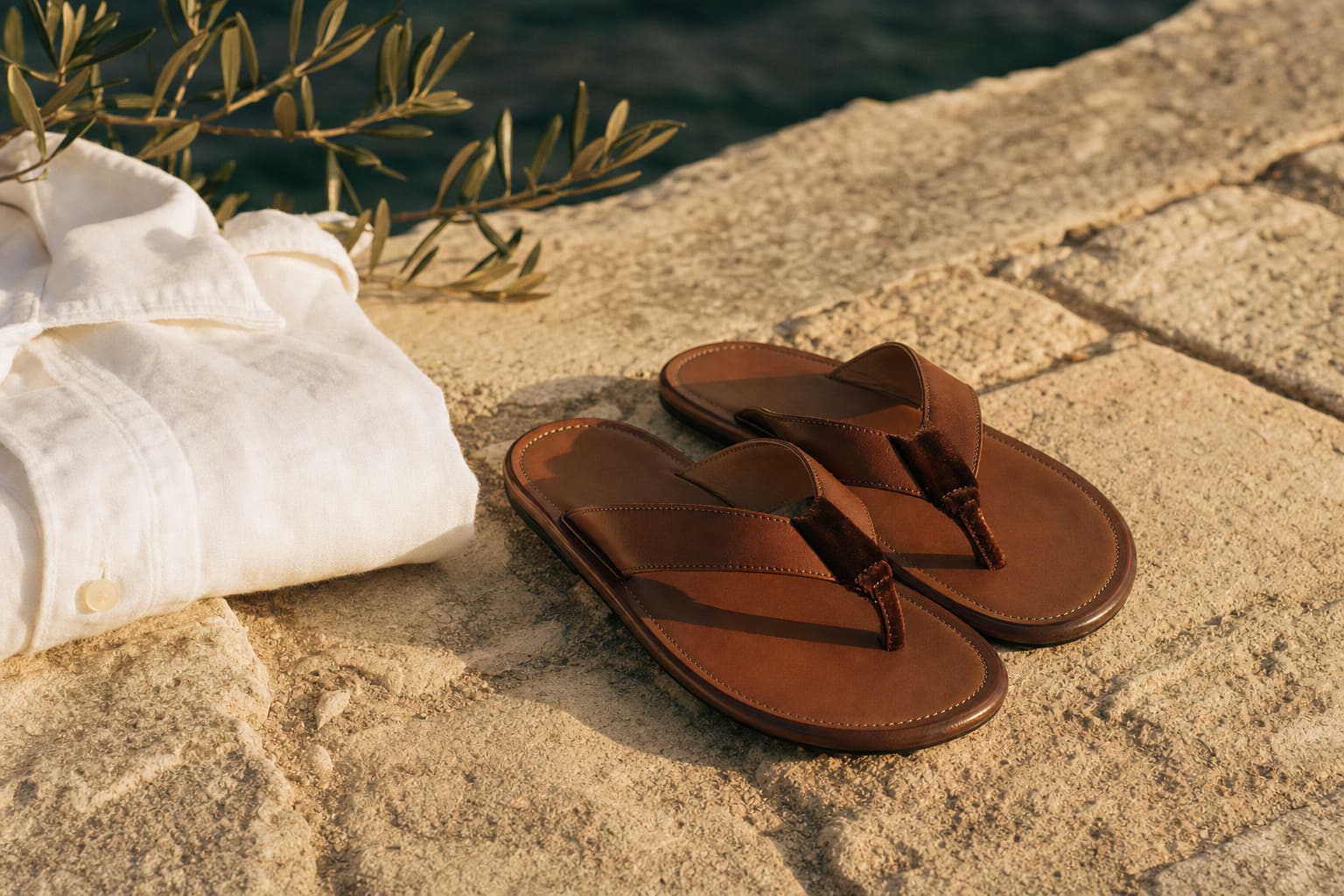
The thong strap is where the difference between leather and rubber becomes most immediately tactile. A rubber thong is rigid and creates a pressure point at the first toe web space. A leather thong, particularly one lined with velvet or suede, distributes pressure across a wider contact area and softens with body heat. The breathable velvet leather flip-flops in our collection use exactly this construction, with a full leather upper and a velvet-lined thong that eliminates break-in discomfort from the first hour of wear.
For broader context on leather grades and tanning methods, this overview of leather production provides a reliable technical foundation.
Expert insightRun your thumb across the back of a leather sandal strap. If the underside is smooth, finished leather, the construction is solid. If it is rough, flaking, or covered with a thin coating, you are looking at bonded or split leather, which behaves more like rubber than full-grain hide.

The Sole Beneath the Surface: Construction Details That Last
The footbed and outsole of a sandal determine durability and comfort in roughly equal measure. Budget rubber sandals are injection-moulded as a single piece, which keeps manufacturing costs low and structural integrity lower. There is no layering, no differentiated cushioning zone, no shank support.
A quality leather sandal uses a layered construction. The footbed is typically a compressed leather or cork board that compresses gradually under your specific weight distribution. The midsole provides cushioning without collapse. The outsole, often rubber or crepe, is bonded and sometimes stitched to the upper layers rather than fused as a single mass. This construction can be resoled, which is the detail that separates a repairable object from a disposable one.
The Lovau Portofino Leather Sandals use a structured leather footbed over a rubber outsole, a combination that provides grip on wet stone terraces while allowing the footbed to take on the shape of the wearer's arch. The Marbella Leather Flip Flops use a similar layered approach with a slightly broader footbed, suited to wider feet or those who spend extended time standing on hard surfaces.
For men who rotate between sandals and closed footwear throughout a Mediterranean trip, our full men's high quality flip-flops collection shows how the same construction logic applies across different silhouettes and price points.
Expert insightPress your thumb firmly into the footbed of any sandal you are considering. A quality leather footbed will compress slightly and return. A cheap EVA foam footbed will compress and stay compressed, which is exactly what happens to your arch support after two days of wear.

The Aesthetic Argument: What Your Sandals Communicate
Style at this level is not about signalling wealth. It is about coherence. A man in well-cut linen trousers and a fine high count white linen shirt wearing bright rubber flip-flops has broken the internal logic of his outfit. The sandal contradicts everything above it.
Leather sandals, by contrast, occupy the same material register as the rest of a considered summer wardrobe. Tan or cognac leather against a high count light blue linen shirt and stone-coloured shorts creates a palette that reads as intentional rather than assembled. The sandal does not announce itself. It completes the picture.
This is the core of old money dressing as it applies to warm-weather footwear. The goal is not a statement shoe. It is a shoe that requires no explanation, that a man in Portofino or Marbella or the Cyclades would wear without a second thought because it is simply the correct object for the occasion. For a deeper look at how sandals fit into a broader summer wardrobe architecture, our article on the best men's sandals for an elegant summer covers the full landscape.
If you find yourself choosing between sandals and loafers for a specific occasion, the breakdown in loafers vs flip-flops: what to wear on a summer holiday will resolve the question precisely.

Cost Per Wear: The Honest Calculation
A cheap rubber sandal at $10 to $15 lasts, under regular summer use, one season. Sometimes less. A leather sandal in the $95 to $120 range, maintained properly, lasts four to six seasons. The arithmetic is straightforward.
At $10 per year for a rubber pair, you spend $50 over five years. At $105 for a leather pair that lasts five seasons, you spend $21 per year. The leather sandal is less than half the cost per season, and that figure does not account for the podiatry visit that flat, unsupported rubber footwear can contribute to over time.
Maintenance is minimal. A leather conditioner applied once or twice a season keeps the footbed supple and the strap from cracking. After a day in salt water, a wipe-down and air-drying in shade, never direct sun, is sufficient. These are five-minute tasks, not a restoration project.
This same investment logic applies across a refined wardrobe. Our article on the best fashion investment pieces for 2026 covers how this principle scales from footwear to outerwear, and why the cost-per-wear framework is the most honest way to evaluate any clothing purchase.
For men building a complete summer shoe rotation beyond sandals, the Ibiza Linen Leather Loafers offer the same construction quality in a closed silhouette suited to evenings and more formal resort settings.

How to Wear Leather Sandals Without Getting It Wrong
The occasions for leather sandals are specific and worth defining clearly. They work on the beach, on a boat deck, at a poolside lunch, on a seafront promenade, at a casual outdoor dinner where the dress code is smart-casual. They do not work in a formal restaurant, at a wedding, or anywhere that requires a closed shoe.
In terms of pairing, the rule is simple: match the leather tone of your sandal to at least one other element in the outfit. Tan sandals with a tan leather belt. Cognac sandals with cognac watch strap hardware. This creates a visual through-line that holds the look together without effort.
For trousers, linen or lightweight cotton in cream, stone, navy, or khaki are the natural companions. Shorts should sit at or just above the knee, in a fabric that has some structure, not jersey or athletic material. A high count navy blue fine linen shirt worn open over a plain white tee, with tan leather sandals and off-white linen shorts, is the kind of outfit that requires no further thought and photographs well from any angle.
For the full footwear picture across seasons and occasions, the men's footwear collection covers every category from sandals through loafers to boots, all built on the same material and construction standards.

| Factor | Cheap Rubber Sandal | Leather Flip-Flop (Quality) |
|---|---|---|
| Material | Injection-moulded EVA or PVC, single piece | Full-grain or vegetable-tanned leather, layered construction |
| Breathability | None, traps moisture and heat against the foot | High, leather wicks moisture and allows airflow |
| Break-in period | Never breaks in, causes friction throughout lifespan | Softens to foot shape within first 2 to 3 wears |
| Average lifespan | 1 season, often less under daily use | 4 to 6 seasons with basic maintenance |
| Cost per season | $10 to $15 per year | $18 to $25 per year across lifespan |
| Repairability | Not repairable, disposable | Resoleable, strap replaceable by a cobbler |
| Aesthetic register | Casual to beach only, clashes with tailored pieces | Smart-casual to resort, pairs with linen and tailored shorts |
Frequently asked questions
Can leather flip-flops get wet in the sea or pool?
Yes, with some care. Full-grain and vegetable-tanned leather handles occasional water exposure well. After contact with salt water, rinse the sandal with fresh water, pat dry with a cloth, and leave to air-dry in shade. Direct sun will dry the leather too quickly and cause cracking. Apply a light leather conditioner once dry. Avoid submerging leather sandals for extended periods or leaving them soaking in standing water.
How do leather flip-flops compare to leather loafers for a summer holiday?
They serve different moments. Leather sandals are correct for the beach, pool, boat, and casual outdoor dining. Leather loafers cover evening meals, town walking, and any setting that requires a slightly more composed look. A well-packed holiday bag includes both. Our breakdown in loafers vs flip-flops: what to wear on a summer holiday maps the exact occasions for each.
What makes velvet-lined thong straps worth the detail?
The thong strap is the primary contact point in a flip-flop, pressing against the first toe web space with every step. Rubber and unlined leather create a friction point that worsens in heat. Velvet lining, a soft woven textile, distributes pressure more evenly and does not generate the same friction. On a sandal worn for six to eight hours a day, that difference is significant. The breathable velvet leather flip-flops use this construction precisely because it resolves the most common complaint about flip-flop comfort.
How do I know if a leather sandal is genuinely full-grain or just labelled as leather?
Inspect the cut edges of the strap and footbed. Full-grain and genuine leather show a fibrous, slightly rough edge when cut. Bonded leather, which is compressed leather dust mixed with adhesive, shows a smooth, plastic-like edge. The back surface of the footbed should feel like suede or slightly textured hide, not like a coated or painted surface. Price is also a reasonable signal: authentic leather construction at a sandal price below $60 is almost always a compromise on hide quality or grade.
The choice between a leather sandal and a rubber one is not really a style debate. It is a decision about whether you want a functional object that lasts and improves, or a disposable one that costs you more across multiple replacements. For the kind of summer wardrobe that holds together from a Sardinian morning to a Greek island evening, the material has to be right. Start with the men's high quality flip-flops collection and choose the construction that will still look considered five seasons from now.