


The Round-Neck T-Shirt Fit Guide for Men 2026
Reading time 14 min • 2745 words
A round-neck t-shirt is the most democratic garment a man owns. It is also the one he almost always wears in the wrong size. Too wide across the chest, too long in the body, sleeves hanging past the elbow: the result is a garment that reads as an afterthought rather than a choice. That is a problem worth fixing properly.
The standard advice, size down, tuck it in, buy the next size, rarely addresses the root cause. Fit is a geometry problem, and every man's geometry is slightly different. This guide works through each measurement point in sequence, from shoulder seam to hem, so you can diagnose exactly where your current tees are failing and correct it.
Fabric matters as much as cut. A tee sewn from a high-count mercerized cotton will hold its shape, drape cleanly, and retain its dimensions after repeated washing. A tee in a loosely spun jersey will distort within a season regardless of how well it fitted at purchase. Both topics, fit and fabric, belong in the same conversation.
Key takeaways
- The shoulder seam is the single most important fit point on a round-neck tee: it must sit exactly at the edge of your shoulder bone, not past it.
- Chest fabric should lie flat with roughly one to two inches of ease on each side, never pulling or billowing.
- Hem length should reach the top of the hip bone, covering the waistband of your trousers by about two centimetres.
- Mercerized cotton holds its shape wash after wash and drapes cleanly against the body, making it the most reliable fabric choice for a refined tee.
- Sleeve hems should end at the mid-bicep, not the elbow, to keep the silhouette sharp and proportionate.
In this guide
- The Shoulder Seam: Where Every Tee Fit Starts
- Chest, Torso, and the Question of Ease
- Sleeve Length and Hem: The Two Points Men Get Wrong Most Often
- Why Mercerized Cotton Changes the Fit Equation
- Colour, Occasion, and Wearing the Round Neck with Intention
- Body Type Adjustments: Practical Fit Notes for Different Builds
- Frequently asked questions
The Shoulder Seam: Where Every Tee Fit Starts
The shoulder seam is the fixed point from which everything else on a t-shirt is calculated. If it sits correctly, the chest, sleeve, and body length all have a reasonable chance of working. If it sits incorrectly, no amount of tucking or rolling will fix the result.
The seam should land exactly at the outer edge of your shoulder bone, the acromion. Run your finger along your shoulder from your neck outward. You will feel a small ridge where the clavicle meets the shoulder joint. The seam should sit on that ridge, not one centimetre past it toward the arm.
When a tee's shoulder seam falls too far down the upper arm, the sleeve cap puckers, the chest fabric pulls horizontally, and the whole upper body looks wider than it is. This is the most common fit failure in mass-market t-shirts, which are cut with generous shoulder widths to accommodate the broadest possible range of customers.
If the seam sits too far inward, toward the neck, the sleeve is too tight across the top of the arm and the chest feels constricted. This is less common but equally problematic.
Practical check: Put the tee on and raise both arms to shoulder height. Lower them. If the shoulder seam slides outward toward the elbow as you lower your arm, the shirt is too wide. If the fabric pulls tight across the upper chest, it is too narrow. A correctly fitting tee should stay in position through both movements.
Expert insightWhen buying online, measure the shoulder width of a tee you already own that fits well at the shoulder seam. Compare it to the brand's flat-lay measurement, shoulder point to shoulder point. This single number is more useful than any size chart.

Chest, Torso, and the Question of Ease
After the shoulder, the chest is the second critical measurement. Ease is the difference between your actual chest measurement and the garment's chest measurement. For a round-neck tee worn as a standalone piece, the correct ease is roughly two to four centimetres on each side, four to eight centimetres total.
That means if your chest measures 100 cm, you want a tee with a chest measurement of 104 to 108 cm. Anything less and the fabric will pull across the pectorals. Anything more and the tee billows at the sides, creating a shapeless silhouette.
The torso below the chest matters too. Many tees are cut with a straight tube body from armhole to hem. This works adequately for slender builds but creates excess fabric at the waist for most men. A tee with a slight taper through the torso, perhaps two to three centimetres narrower at the hem than at the chest, will sit far more cleanly against the body without feeling tight.
For men who train regularly and carry more width across the shoulders and chest relative to the waist, the challenge is sharper. Sizing up to accommodate the chest almost always creates too much fabric at the waist. In this case, a tee with a more athletic cut, wider at the chest and shoulders, with a more pronounced taper, is the correct solution rather than a standard cut in a larger size.
Our high-count mercerized round-neck tees are cut with this considered taper, which is why they read as fitted without restricting movement.
Expert insightLay your tee flat and measure the chest one centimetre below the armhole seam. Double that number. Compare it to your actual chest circumference. The difference is your ease. Write this number down for every brand you buy from.

Sleeve Length and Hem: The Two Points Men Get Wrong Most Often
Sleeve length on a round-neck tee should end at the mid-bicep. That is roughly halfway between the shoulder seam and the elbow. This proportion frames the arm correctly and reads as intentional. Sleeves that end at the elbow look like a garment that has been washed too many times. Sleeves that end above the mid-bicep can look truncated unless the tee is specifically designed as a muscle-fit silhouette.
The sleeve hem itself should lie flat around the arm without digging in or gaping. A ribbed sleeve hem that digs into the upper arm indicates the sleeve circumference is too narrow for your arm size, not that the overall tee is too small.
Hem length is where most men default to buying too long. The standard guidance is that the hem should end at the top of the hip bone, covering the trouser waistband by roughly two centimetres when untucked. This length works untucked with chinos, untucked with shorts, and when tucked, it creates a clean tuck without excess bunching at the front.
A tee that hangs four or five centimetres below the hip bone will always look sloppy untucked and will bunch visibly when tucked. This is the second most common fit failure after the shoulder seam.
If you plan to wear the tee tucked, particularly with tailored trousers or a higher-waisted trouser, a slightly longer hem is acceptable and will stay tucked more reliably. In that case, add two to three centimetres to the standard length rather than buying a size up.
For a refined untucked look paired with old money style trousers and separates, the shorter, hip-bone hem is always the cleaner choice.

Why Mercerized Cotton Changes the Fit Equation
Fabric is not a secondary consideration in fit. It is a primary one. A tee cut to the right measurements in a low-quality jersey will still fit poorly, because the fabric distorts, stretches out at the collar, bags at the elbows, and loses its dimensions after ten washes.
Mercerized cotton is cotton that has been treated under tension with a sodium hydroxide solution, a process developed by John Mercer in the 1840s and refined through the twentieth century. The treatment causes the cotton fibres to swell, become rounder in cross-section, and align more uniformly. The practical results are significant: higher tensile strength, better dye absorption, a natural sheen, and critically, improved dimensional stability. A mercerized cotton t-shirt for men holds its shape across repeated laundering in a way that standard jersey does not.
You can read more about the mercerization process and its effect on textile properties via Wikipedia's article on mercerisation, which covers the chemistry in useful detail.
High thread count matters alongside mercerization. A higher-count yarn produces a finer, denser fabric that drapes more cleanly against the body, resists pilling, and retains its cut dimensions over time. This is why the fit of a quality tee in the first wash should be essentially the same as the fit two years later.
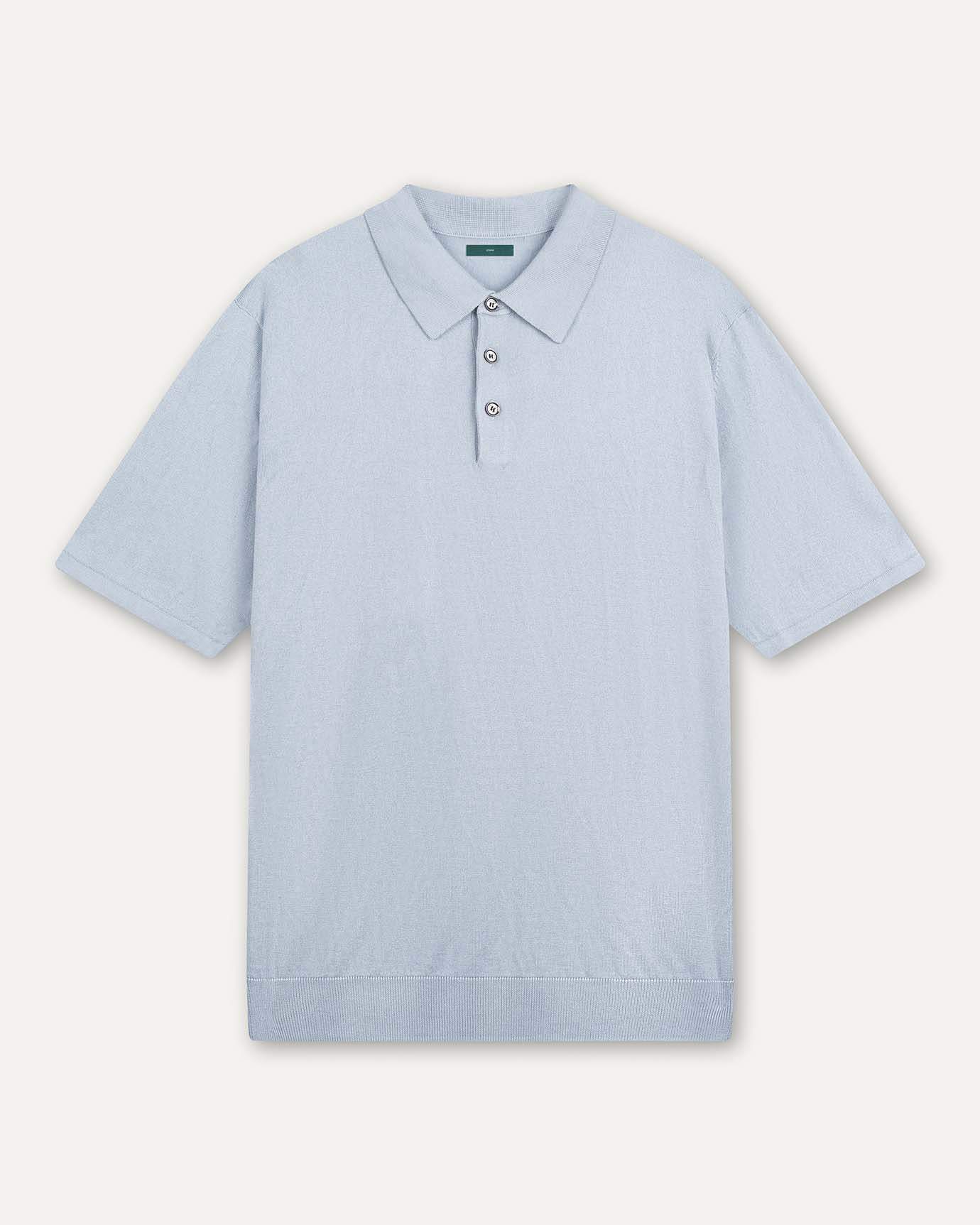
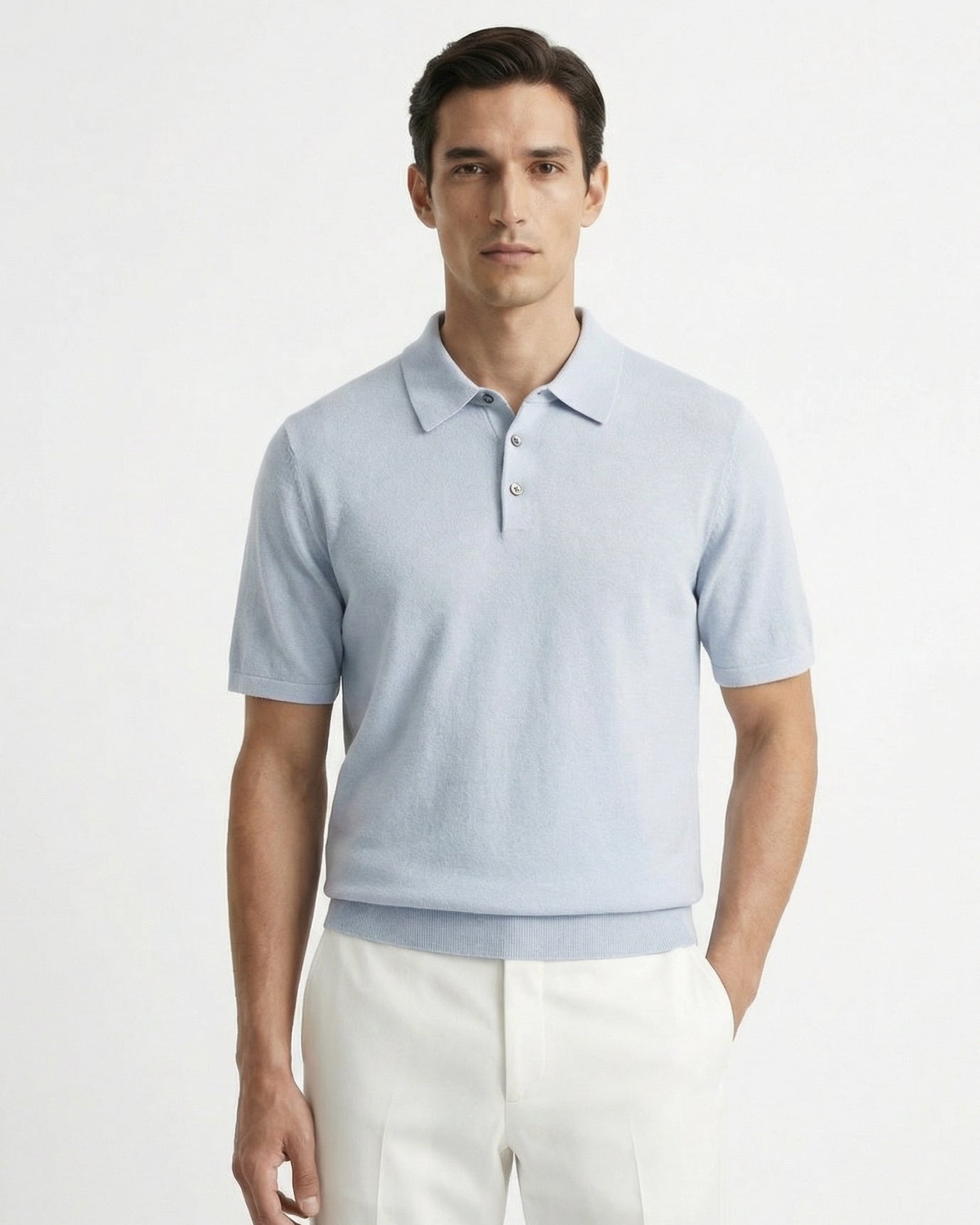
The light blue mercerized round-neck tee and the black mercerized round-neck tee both illustrate this quality: the fabric has enough body to hold the shoulder seam in place and enough drape to follow the torso without clinging. That combination is what distinguishes a tee that looks considered from one that looks incidental.
For warm-weather wear, the breathability of high-count mercerized cotton is also relevant. The tighter weave allows moisture to wick away from the skin more efficiently than a loose-spun jersey, which means the tee keeps its shape even when worn in heat.
Expert insightTurn a tee inside out and look at the fabric construction near the collar seam. A high-count mercerized fabric will look uniform and tight-woven. A low-count jersey will show visible loops and gaps in the knit. This is a reliable quality indicator available to you before purchase.

Colour, Occasion, and Wearing the Round Neck with Intention
A round-neck tee worn well is a complete statement. It does not require a blazer to look deliberate, though it pairs well with one. The key is treating the colour and pairing with the same attention you would give any other garment.
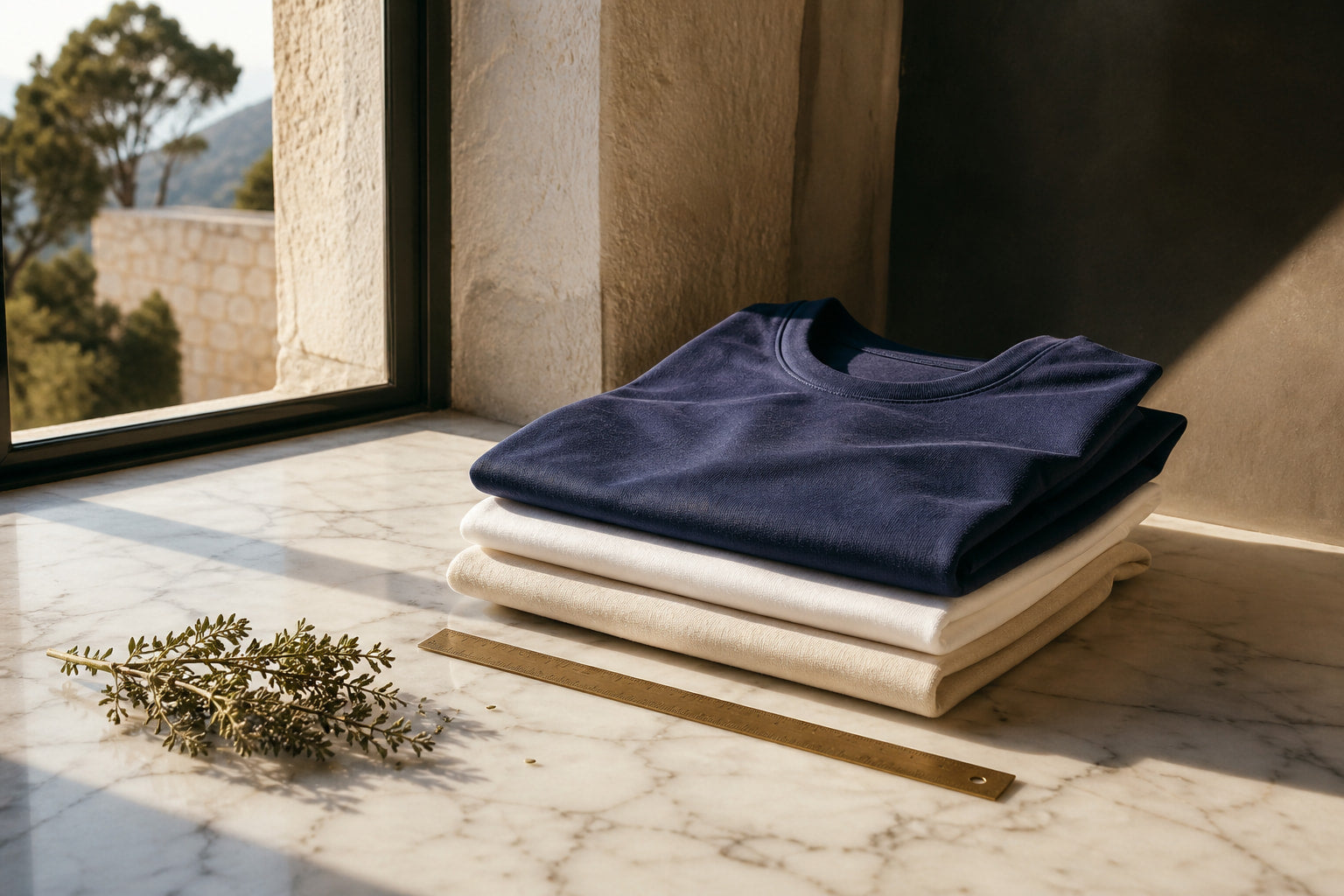
Neutral and mid-tone colours are the most versatile. White, oatmeal, light blue, and navy cover the majority of occasions where a tee is appropriate: summer weekends, casual Friday at the office, travel, coastal dining. The oatmeal mercerized round-neck tee is particularly useful because it reads as warmer than white and pairs naturally with camel, navy, stone, and mid-grey.
Deeper tones such as the dark navy round-neck tee carry more visual weight and work well as the base of a layered outfit: under an unstructured linen blazer, beneath a lightweight overshirt, or worn alone with well-cut chinos in a contrasting pale tone.
Accent colours such as the green tea mercerized tee or the pink mercerized tee require more considered pairing. Keep the rest of the outfit in neutrals and let the tee carry the colour. One intentional colour choice per outfit is the principle that keeps a casual look from reading as haphazard.
For occasions that require a step up from a plain tee, the French Riviera Mediterranean T-Shirt and the Belle Montecarlo T-Shirt offer graphic interest that still sits within the understated register. These work well with old money footwear and simple tailored shorts or chinos.
Permanent Style has written clearly about the role of the plain tee in a considered wardrobe, noting that quality and fit, not brand or price alone, determine whether a tee reads as deliberate. The principle holds: a well-fitted luxury tee from a house that thinks seriously about cut and fabric will always read better than an expensive tee bought in the wrong size.

Body Type Adjustments: Practical Fit Notes for Different Builds
Standard size charts assume a proportional relationship between chest, waist, and height that most men do not actually have. Here are the specific adjustments worth making for the most common build variations.
Broad shoulders, narrower waist: Size to the shoulder seam measurement first. Accept that the chest will have slightly more ease than ideal. Avoid sizing down to reduce waist volume, as this will pull the shoulder seam inward and create the chest-pulling problem described above.
Narrower shoulders, fuller midsection: This is the hardest build to fit in a standard tee. A size that accommodates the midsection will almost always have shoulder seams sitting too far down the arm. Look for brands that offer a shorter shoulder width relative to chest circumference, or consider a slightly longer tee that you can half-tuck to break the horizontal line at the waist.
Tall and lean: Standard tees will often be too short in the body and too narrow in the chest. A long-and-lean cut, or a size up combined with a tuck, is the pragmatic solution. The high-end mercerized ice silk tees are cut with a slightly longer body than the standard round-neck range, which suits taller proportions.
Shorter stature: The most important adjustment here is hem length. A tee that hits even one centimetre below the hip bone will visually shorten the leg line. Prioritise tees with a hem that sits precisely at the hip bone, and avoid any tee where the hem reaches toward the upper thigh. Keeping the tee untucked in a clean, short hem is always more proportionate than tucking a too-long tee.

| Fabric | Fit Retention After Washing | Drape Quality | Care | Best Occasion |
|---|---|---|---|---|
| High-count mercerized cotton | Excellent, minimal distortion | Clean, structured drape | Machine wash cold, low tumble | Smart casual, travel, coastal dining |
| Standard cotton jersey | Moderate, collars stretch over time | Soft but loose | Machine wash, some shrinkage | Everyday, casual only |
| Mercerized cotton ice silk blend | Very good, slightly more fluid | Fluid, close to skin | Machine wash cold, gentle | Warm weather, resort, evening casual |
| Lyocell cotton blend | Good, slight relaxation after first wash | Soft, fluid drape | Machine wash cold, reshape damp | Summer, relaxed smart casual |
| Synthetic jersey (polyester mix) | Good shape retention | Flat, less natural | Machine wash, easy care | Sport-adjacent, not recommended for refined looks |
Frequently asked questions
How tight should a round-neck t-shirt fit across the chest?
The fabric should lie flat with no pulling or puckering when you stand normally. Aim for roughly two to four centimetres of ease on each side of the chest, meaning the shirt's chest measurement should be four to eight centimetres larger than your actual chest circumference. If you can see the outline of your chest muscles clearly through the fabric under normal lighting, the tee is too tight.
Should I size up or down if a t-shirt fits well at the shoulder but is loose in the body?
Neither. Sizing down to reduce body volume will pull the shoulder seam inward and create a worse problem. The correct solution is to look for a brand that cuts with a more tapered body relative to the shoulder width, or to choose a tee designed with a slightly athletic taper. Our high-count mercerized round-neck tees are cut with this taper built in.
Does mercerized cotton shrink in the wash?
High-count mercerized cotton shrinks significantly less than standard cotton jersey, because the mercerization process stabilises the fibre structure. Washing in cold water and avoiding high-heat drying will keep shrinkage to a minimum. Expect no more than one to two percent dimensional change after the first wash, which is well within normal tolerance.
Can a round-neck t-shirt look appropriate for smart casual occasions?
Yes, provided the fit is precise, the fabric is quality, and the colour is considered. A well-fitted mercerized cotton tee in navy or white worn with tailored chinos and leather loafers reads as smart casual without effort. The distinction between a tee that looks casual and one that looks careless is almost entirely in the fit and fabric, not the garment category itself.
Fit failures in t-shirts are almost always predictable and almost always correctable once you know where to look. Shoulder seam first, chest ease second, hem length third, fabric quality throughout. Work through those points in order and you will not need to buy another tee that disappoints. For a starting point that removes most of the fabric variable from the equation, the mercerized cotton round-neck tee collection gives you the dimensional stability to focus entirely on finding the right cut for your build.