


The Ultimate Guide to Men's Sock Etiquette and Going Sockless
Reading time 12 min • 2441 words
Few details in a man's wardrobe are inspected as closely as his socks, precisely because they are so small. Sit down in a chair, cross a leg, and suddenly several centimetres of hosiery are on full display. Whether those centimetres communicate polish or carelessness depends entirely on choices most men make in under thirty seconds each morning.
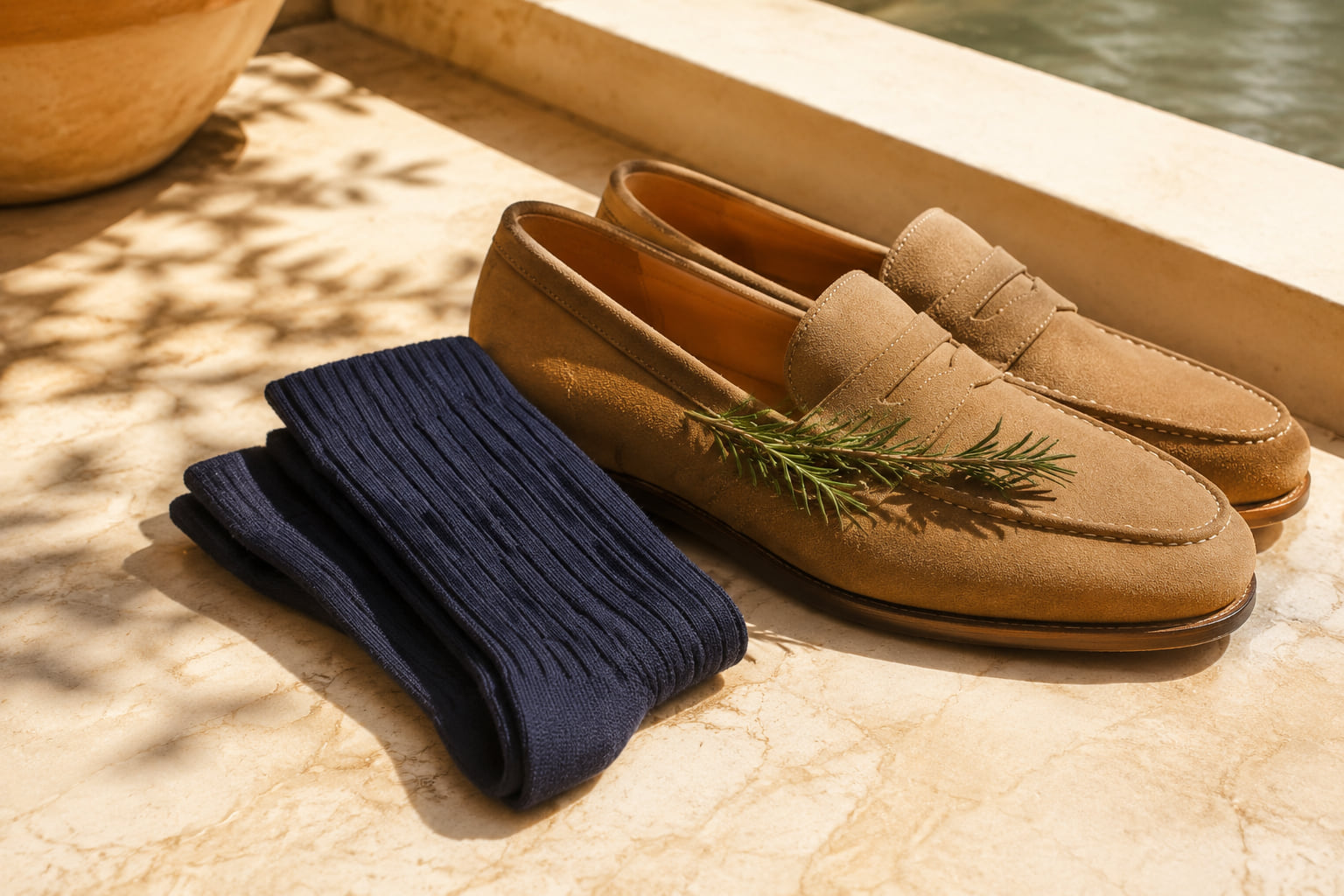
The etiquette around men's hosiery has a long, codified history, but it is not rigid. It is contextual. The same ankle that demands a fine merino sock in a Milanese boardroom can go bare inside a suede loafer on the Amalfi coast without any loss of dignity. The difference lies in understanding the logic behind the rules, not just memorising them.
This guide covers the full range: which fabrics suit which occasions, the colour and pattern logic that holds across every dress code, and the precise conditions under which going sockless is genuinely appropriate rather than merely convenient.
Key takeaways
- Match sock weight and fibre to the formality and season of the outfit, not just the colour.
- The trouser hem is your sock's frame: a proper break controls how much sock shows and when.
- Going sockless is acceptable in warm weather with loafers or canvas shoes, never with lace-up dress shoes.
- No-show liners are a practical compromise for casual warm-weather outfits but are not a substitute for real socks in formal or business contexts.
- Sock colour should echo either the trouser or the shoe, never contrast both at once unless the rest of the outfit is deliberately monochrome.
In this guide
- The Sock Fabric Hierarchy: What You Should Actually Be Wearing
- Sock Colour and Pattern Rules That Actually Hold
- Length, Fit, and the Trouser Break: The Technical Side
- Going Sockless: When It Works and When It Does Not
- Dress Code Contexts: A Practical Reference by Occasion
- Care, Storage, and Making Socks Last
- Frequently asked questions
The Sock Fabric Hierarchy: What You Should Actually Be Wearing
Fabric is the starting point for all hosiery decisions. The fibre determines comfort, durability, and the visual weight of the sock, all of which need to align with the rest of your outfit.
Merino wool is the most versatile dress-sock fibre available. It regulates temperature, resists odour, and has a fine enough gauge to sit cleanly inside a leather shoe without bunching. A mid-calf merino sock in plain navy, charcoal, or forest green is appropriate from business formal down to smart casual.
Cotton socks, particularly Egyptian or pima cotton, are the correct choice for warm-weather dressing. They breathe more freely than synthetics and sit well under lightweight trousers. A ribbed cotton sock in a mid-weight gauge pairs cleanly with linen blend trousers in a herringbone double pleat without adding visual bulk at the ankle.
Cashmere and silk blends are reserved for formal occasions and cold-weather dressing at the highest register. They are thin, smooth, and expensive to maintain, which is precisely the point. They signal that every layer of an outfit has been considered.
Avoid polyester-dominant socks in any context above truly casual. They retain heat, retain odour, and have a synthetic sheen that reads poorly next to quality leather or fine wool cloth.
As a practical guide, the Gentleman's Gazette's detailed breakdown of sock construction confirms that the fibre content printed on the label is the single most reliable predictor of how a sock will perform and age.
Expert insightBuy socks by weight, not just by colour. A heavy-gauge rib sock in a dark shade will always look more casual than a fine plain-knit sock in the same shade. Adjust the gauge before you adjust the colour.

Sock Colour and Pattern Rules That Actually Hold
The classic rule, match your socks to your trousers, exists because it visually extends the leg line and avoids any break in the silhouette when seated. It is a sound rule and a safe default, but it is not the only valid approach.
The second valid approach is matching the sock to the shoe. A tan sock with a tan loafer, a dark brown sock with a dark brown Oxford, creates a visual anchor at the foot rather than extending the trouser. This works particularly well with cropped or tapered trousers where a small amount of sock is always visible.
What does not work is a sock that contrasts both the shoe and the trouser simultaneously without any deliberate design logic. A bright sock worn for its own sake against a muted outfit is rarely the statement its wearer intends.
Pattern rules: - Plain ribs are the most versatile and appropriate for business and formal contexts. - Small-scale patterns (clocks, pin dots, fine stripes) are acceptable in smart casual and business casual settings, provided the pattern scale is smaller than anything else in the outfit. - Bold patterns (argyle, large stripes, novelty motifs) belong in casual weekend dressing only, and only when the rest of the outfit is restrained enough to absorb them.
For a complete overview of how hosiery fits within a broader wardrobe strategy, the luxury capsule wardrobe checklist for men is worth reading alongside this guide.
Expert insightPattern scale is the most commonly ignored rule. A fine houndstooth trouser and a large argyle sock worn together create visual noise at the ankle that no amount of good tailoring can correct.

Length, Fit, and the Trouser Break: The Technical Side
Sock length is not a matter of preference. It is a matter of function and appropriateness.
Mid-calf (over-the-calf) socks are the correct choice for any formal or business context. They stay up without requiring garters, they do not slip during the day, and they ensure that no skin is visible when you cross your legs. This is the standard that has been observed in European tailoring for over a century, and for good reason.
Ankle socks are strictly casual. They are appropriate with trainers, casual loafers, and canvas shoes. They are not appropriate with any trouser that has a tailored cut or a proper break.
No-show liners occupy a specific niche: warm-weather casual outfits where you want the sockless look without the hygiene and shoe-damage issues that come with genuinely bare feet inside leather. They are a practical tool, not a style statement. Use them with Monaco linen shorts and loafers on a summer afternoon, not with trousers in a professional setting.
The trouser break determines how much sock is visible and therefore how much it matters. A full break covering the shoe almost entirely means the sock is rarely seen. A cropped or no-break trouser, such as the Naples striped high-waisted trousers, puts the sock in constant view. The shorter the break, the more considered the sock choice needs to be.
Expert insightOver-the-calf socks are one of the few wardrobe items where spending more money produces a directly visible return. Cheap over-the-calf socks lose their elasticity within months and begin to pool at the ankle, which is worse than wearing ankle socks in the first place.

Going Sockless: When It Works and When It Does Not
Going sockless is not a shortcut or a casual habit that crept into menswear. It has a specific history in Mediterranean resort dressing, where warm temperatures, soft leather shoes, and relaxed tailoring created a context in which bare skin at the ankle was not only acceptable but appropriate.
The conditions that make sockless dressing work are specific:
- Shoe type: Loafers, boat shoes, and canvas espadrilles are designed to be worn without socks. British style Chelsea boots in genuine leather sit in the middle ground and can work sockless in warm weather with the right outfit. Lace-up dress shoes, brogues, and formal Oxfords should never be worn without socks. The construction of these shoes assumes a sock will be present, and wearing them without one accelerates deterioration of the lining and produces visible discomfort.
- Trouser type: Lightweight, unlined trousers in linen or cotton are the natural companion to the sockless look. The Paris linen trousers in a relaxed cut work well here. Heavy wool trousers, pleated formal trousers, and any trouser with a full break look incongruous with a bare ankle.
- Temperature and occasion: Going sockless is a warm-weather choice. It is appropriate for resort, weekend, and smart casual settings. It is not appropriate for business formal, black tie, or any context where a jacket and tie are required.
For a deeper look at how footwear choices shape the overall old money aesthetic, the article on stealth wealth footwear and suede loafers covers the logic in full.
The history of loafers as a style category is worth understanding here: the shoe was originally designed as a leisure shoe, and that origin still defines the contexts in which it, and the sockless convention associated with it, remains appropriate.

Dress Code Contexts: A Practical Reference by Occasion
The sock rules shift meaningfully across dress codes, and conflating them is one of the most common errors in otherwise well-dressed men.
Black tie and formal: Over-the-calf silk or fine merino socks in black or midnight navy only. No exceptions, no patterns, no skin.
Business formal and business professional: Over-the-calf merino or cotton socks in plain or fine-rib dark tones. Colour should match the trouser. Worn with Italian trousers in worsted wool or the business grey trousers in herringbone, a plain charcoal or dark navy sock is always correct.
Business casual: More latitude on colour and fine pattern. Ankle socks remain inappropriate. Cotton or merino mid-calf socks in a broader range of tones work here, including burgundy, olive, and camel.
Smart casual: The transition zone. A visible ankle is acceptable if the shoe and trouser combination supports it. No-show liners are acceptable. Light-coloured socks in cotton or linen blends come into play.
Resort and casual: Sockless is appropriate. No-show liners are appropriate. Bold-pattern socks with trainers are appropriate. The Marbella square collar linen shirt worn open with linen shorts and loafers is the archetype of this category.
For a complete framework of how these dress codes interact with a broader wardrobe strategy, the best old money style guide for men provides the wider context.

Care, Storage, and Making Socks Last
Socks are a high-frequency item. They are washed more often than almost any other garment, which means fibre degradation happens quickly if care is poor.
Merino and cashmere socks should be washed inside-out in cold water on a gentle cycle, or hand-washed. Tumble drying destroys the fibre structure and shrinks the foot. Lay flat to dry.
Cotton socks are more forgiving but still benefit from a cool wash and air drying. High heat yellows white cotton and weakens the elastic in the cuff.
Storage: Sort by colour and weight, not by occasion. This makes the morning decision faster and more accurate. Rolling socks into balls stretches the cuff over time. Fold them flat or use a small drawer divider.
When to replace: A sock that has lost tension in the cuff, developed thin patches at the heel or toe, or faded significantly in colour should be replaced. A poor-condition sock worn with a well-maintained outfit is a contradiction that careful dressing cannot survive.
The same attention to fibre care that applies to socks applies to every fine garment. The article on how to care for linen clothing in summer covers many of the same principles for the warm-weather pieces that most commonly accompany sockless dressing.
| Occasion | Sock Length | Fibre | Colour Range | Pattern |
|---|---|---|---|---|
| Black Tie / Formal | Over-the-calf | Silk or fine merino | Black, midnight navy | Plain only |
| Business Formal | Over-the-calf | Merino wool or pima cotton | Charcoal, navy, dark brown | Plain or fine rib |
| Business Casual | Over-the-calf | Cotton or merino | Navy, burgundy, olive, camel | Fine rib or small pattern |
| Smart Casual | Mid-calf or no-show liner | Cotton or linen blend | Any muted tone | Small to medium pattern |
| Resort / Casual Warm Weather | No-show liner or sockless | Cotton liner or none | N/A | N/A |
| Weekend Casual | Ankle or mid-calf | Cotton | Broad range | Bold patterns acceptable |
Frequently asked questions
Is it acceptable to go sockless with dress trousers?
Only in warm-weather smart casual contexts and only with the right shoe. Loafers worn with Paris linen trousers on a summer evening is a legitimate and well-established combination. The same trousers worn sockless with lace-up Oxfords in a business meeting is not. The shoe type is the deciding factor, not the trouser alone.
What colour socks should I wear with navy trousers?
The safest choice is a matching navy or dark blue sock, which extends the leg line and reads as intentional. A dark burgundy or forest green sock also works with navy if the shoe is brown or tan leather, creating a considered tonal contrast. Avoid grey socks with navy trousers, the combination tends to look accidental rather than deliberate.
Are no-show socks a real style choice or just a compromise?
They are a practical compromise, and there is nothing wrong with that. No-show liners serve a specific purpose: protecting the shoe lining and preventing blisters when wearing loafers or boat shoes in warm weather without the visual bulk of a full sock. They are not appropriate in formal or business contexts, but within their correct application they are a sensible tool.
How do I stop my socks from slipping down during the day?
The primary cause of sock slippage is poor elastic quality in the cuff, which is a fibre and construction issue rather than a fit issue. Over-the-calf socks stay up through compression rather than relying solely on cuff elastic, which is why they are the preferred choice for formal wear. If your mid-calf socks slip, the most effective solution is replacing them with over-the-calf socks in a higher-quality merino or cotton construction, rather than adjusting how you wear them.
Socks are the one garment that no one notices when they are right and everyone notices when they are wrong. The rules here are not arbitrary, they follow the same logic as every other element of considered dressing: fabric suited to occasion, colour that serves the overall composition, and length appropriate to the formality of the setting. Going sockless follows the same logic, it works precisely because the conditions that allow it, warm weather, the right shoe, relaxed tailoring, are specific and well-defined. For men building a wardrobe where every detail holds up to scrutiny, the old money menswear collection at Lovau provides the foundational pieces that make these choices straightforward rather than laborious.