


Mercerized Cotton vs Regular Cotton T-Shirts: What's the Difference?
Reading time 13 min • 2626 words
Most men have never paused to ask what the word mercerized actually means on a garment label. It appears on premium basics, it usually comes with a higher price, and the fabric does feel different in the hand, but the reason why is rarely explained clearly.
The difference is not a marketing invention. It comes from a specific industrial process that permanently changes the structure of the cotton fiber itself, affecting everything from sheen and color depth to durability and breathability. Understanding it takes about five minutes and will change how you shop for basics for the rest of your life.
This guide covers the science in plain language, the practical differences you will notice when wearing each type, and the situations where one is clearly the better choice.
Key takeaways
- Mercerization is a chemical treatment that permanently restructures cotton fibers, making them rounder, smoother and more lustrous.
- Mercerized cotton absorbs dye more deeply, so colors stay richer and more accurate after repeated washing.
- The fabric has a subtle sheen that reads as refined rather than shiny, closer to a fine poplin than a standard jersey.
- High thread-count mercerized cotton is noticeably lighter and more breathable than standard cotton of the same weight.
- A well-made mercerized cotton tee can anchor a smart-casual outfit in a way a basic jersey tee cannot.
In this guide
- What Mercerization Actually Does to Cotton
- Regular Cotton: What You Are Actually Wearing in a Standard Tee
- The Practical Differences You Will Notice When Wearing Each
- When to Choose Mercerized Cotton Over Standard Cotton
- Reading the Label: What to Look for When Buying
- How Mercerized Cotton Fits into a Considered Wardrobe
- Frequently asked questions
What Mercerization Actually Does to Cotton
Mercerization is a treatment invented in 1844 by the English textile chemist John Mercer. The process involves immersing cotton yarn or fabric under tension in a concentrated solution of sodium hydroxide, then neutralizing it with an acid rinse. The mercerization process causes each individual cotton fiber to swell, lose its natural flat, ribbon-like cross-section and become rounder and more uniform along its length.
The result of that structural change is threefold. First, the surface of the yarn becomes smoother, which reflects light more evenly and produces the characteristic soft luster that distinguishes mercerized cotton from standard jersey. Second, the rounder fiber cross-section allows dye molecules to penetrate the fiber more deeply and evenly, producing colors that are noticeably richer and more stable over time. Third, the treated fiber is measurably stronger than untreated cotton, which translates directly into longer garment life.
Double mercerization, used in some higher-specification fabrics, applies the process twice, once to the yarn before weaving and once to the finished fabric. The result is a more pronounced sheen and an even tighter, more consistent surface. Our double mercerized lyocell cotton long sleeve t-shirt uses this approach, combining the treatment with lyocell fiber for additional drape and breathability.
None of this is a surface finish that washes away. The structural change to the fiber is permanent, which is why a quality mercerized cotton garment retains its appearance through years of regular washing in a way that standard cotton simply does not.
Expert insightLook at the garment label for the phrase 'high-count' alongside mercerized. Thread count in a knit tee refers to the fineness of the yarn used. Higher count means a finer, denser fabric with better drape and a cleaner surface, two qualities that matter significantly in a garment worn against the skin.

Regular Cotton: What You Are Actually Wearing in a Standard Tee
Standard cotton jersey, the fabric in most everyday t-shirts, is made from carded or combed cotton spun into yarn and then knit into a fabric without any chemical treatment to the fiber itself. Combed cotton is a step above carded because short, weak fibers are removed before spinning, producing a cleaner, softer yarn. But neither is mercerized.
The resulting fabric is comfortable, breathable and familiar. It is also matte in appearance, prone to pilling at points of friction, and tends to absorb dye less evenly, which is why cheaper cotton tees can look slightly uneven in color even when new. After a dozen washes, the surface begins to develop a faded, slightly fuzzy texture that reads as casual at best and worn-out at worst.
For a basic tee worn under a shirt or for purely informal occasions, standard combed cotton is perfectly adequate. The Old Money Cotton T-Shirt in White is a good example of how quality combed cotton, cut with the right proportions and finished carefully, can still produce a garment that looks correct in a smart-casual context. The same applies to the Old Money Cotton T-Shirt in Black, a reliable foundation piece for a pared-back wardrobe.
The honest limitation is longevity and visual refinement. If you want a tee that holds its shape, color and surface quality for three or four years of regular wear, standard cotton requires more careful laundering and will still show its age faster than a mercerized equivalent.

The Practical Differences You Will Notice When Wearing Each
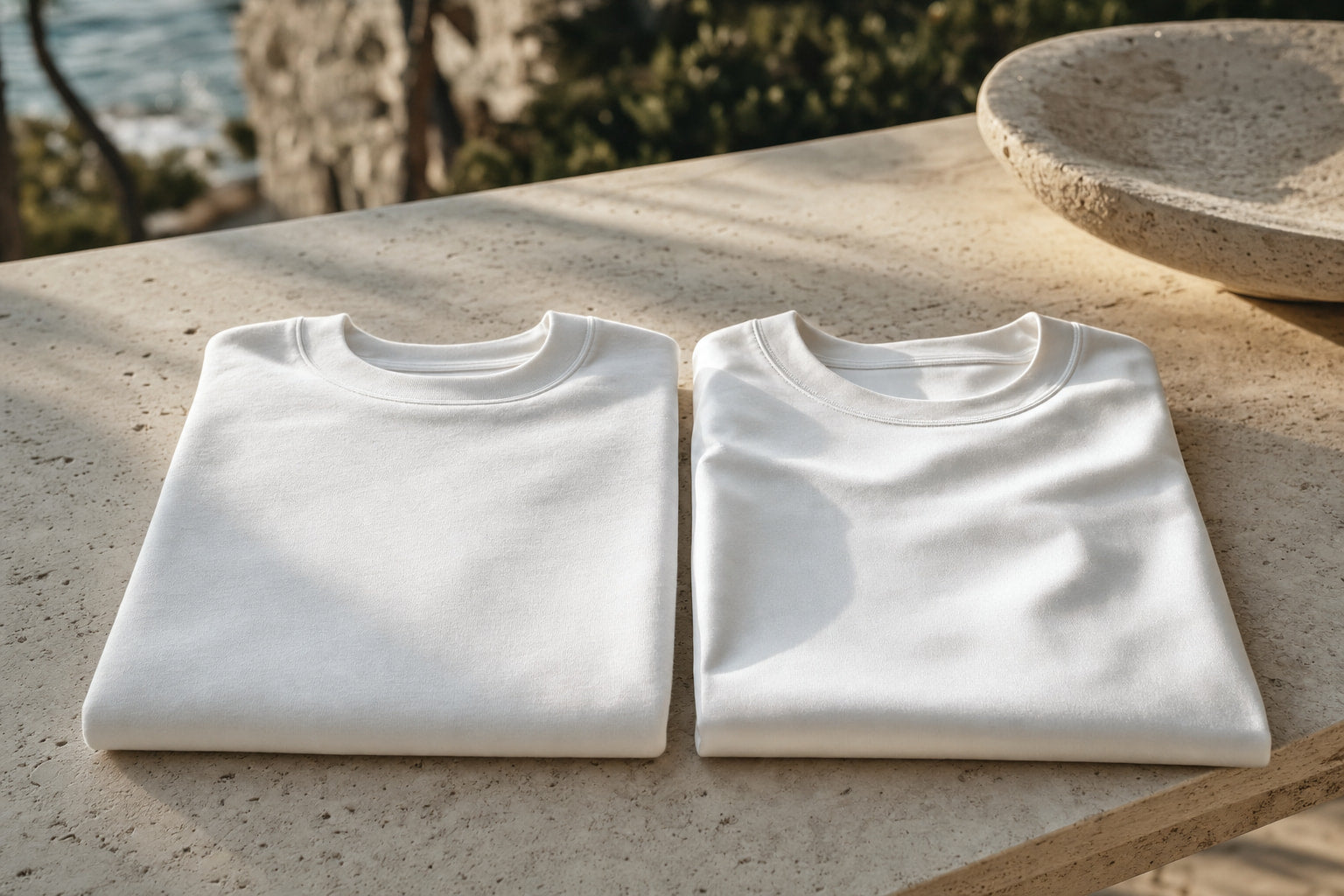
Put a standard cotton tee and a quality mercerized cotton tee side by side and the differences are immediate.
Surface and sheen. The mercerized fabric has a quiet luster, not glossy, not synthetic-looking, but visibly more refined than the flat matte of standard jersey. In natural or warm artificial light it reads as expensive in the way that a fine poplin shirt does. This is what makes a mercerized tee work under a linen blazer or with tailored trousers in a way that a basic jersey tee cannot quite manage.
Hand feel. Mercerized cotton is smoother and cooler to the touch. Particularly in high-count constructions, the fabric feels closer to a fine shirting fabric than a casual knit. The mercerized cotton ice silk white t-shirt is a good reference point for this: the term 'ice silk' in the product name refers to the cool, smooth hand that high-count mercerized cotton produces.
Color retention. Because dye penetrates more deeply into the mercerized fiber, colors remain accurate and saturated after repeated washing. Compare a navy mercerized tee to a standard cotton navy tee after ten washes and the difference is visible. The dark navy mercerized cotton round neck tee is a good example of a color that benefits substantially from this property.
Breathability and weight. High-count mercerized cotton is typically knit from finer yarn, which produces a lighter, more breathable fabric at a given thickness. For warm-weather wear, this is a meaningful practical advantage. Our guide to the best summer fabrics for hot weather covers this in more detail alongside linen and other warm-weather options.
Durability. The mercerization process strengthens the fiber. A well-made mercerized cotton tee will resist pilling and surface degradation significantly longer than a standard jersey equivalent, assuming comparable construction quality.
Expert insightWash mercerized cotton at 30 degrees on a gentle cycle and hang to dry away from direct sunlight. The fiber is stronger than standard cotton but heat, particularly from a hot tumble dryer, will degrade the sheen over time. Cold water and low heat preserve the surface quality that justifies the price.

When to Choose Mercerized Cotton Over Standard Cotton
The choice is not always mercerized. Context matters.
For a tee worn entirely under a shirt, a standard combed cotton crew neck is the rational choice. It will not be seen, it will be washed frequently, and the visual properties of mercerized fabric are irrelevant. Similarly, for heavy physical activity or beach use, the extra cost of mercerized cotton does not serve a practical purpose.
Mercerized cotton earns its place in three specific scenarios. The first is the standalone tee, worn without a jacket or shirt over it, in a context where the garment needs to read as intentional rather than simply comfortable. Paired with well-cut chinos, leather loafers and a watch, a quality mercerized tee in a solid neutral is a complete, coherent outfit. The light blue mercerized cotton round neck tee works particularly well in this register, the color sitting cleanly against tan skin in summer.
The second scenario is smart-casual layering. Under a linen or cotton blazer, the sheen of a mercerized tee is visible at the collar and sleeve, and it contributes to the overall impression of care. A standard matte jersey tee in the same position looks underdressed by comparison.
The third is simply longevity. If you are building a wardrobe of fewer, better pieces, as the old money approach to men's style advocates, then investing in tees that hold their quality over years rather than months is the more economical choice in the long run. For a broader view of how to build that foundation, our article on the best neutral t-shirts for an old money look is a useful reference.

Reading the Label: What to Look for When Buying
Not all mercerized cotton is equivalent. The label tells you the process was applied, but it does not tell you the quality of the base fiber or the thread count of the construction. Here is what to look for beyond the word mercerized.
Fiber origin and length. Long-staple cotton varieties, Pima and Egyptian cotton being the most well-known, produce finer, stronger yarn before mercerization even begins. Mercerizing long-staple cotton produces a noticeably superior result compared to mercerizing standard short-staple fiber. If a label specifies Pima or Egyptian cotton alongside mercerized, that is a reliable signal of quality.
Thread count or yarn count. In knit fabrics, this is expressed as a number with Nm (metric count) or Ne (English count). Higher numbers indicate finer yarn and a denser, smoother fabric. The high-count mercerized range at Lovau, including options like the green tea mercerized cotton round neck tee and the oatmeal mercerized cotton round neck tee, uses finer yarn construction specifically to achieve the breathability and drape that distinguishes a premium basic from a commodity one.
Construction and finish. Check the seams. A quality mercerized tee will have flat-lock or fine overlock seams that do not create pressure points or visible bulk. The collar and sleeve hems should lie flat without curling. These details are not incidental; they indicate whether the manufacturer treated the fabric with the same care that the mercerization process deserves.
For a deeper read on what mercerized cotton means in the context of premium basics more broadly, our dedicated article on mercerized cotton and why it matters for premium basics covers the topic in full. And if color selection is your next question after fabric, the best colors for men's t-shirts provides a practical framework.
Expert insightThe term 'ice silk' you will see on some labels is not a fiber name. It describes the tactile quality of very high-count mercerized cotton, smooth, cool and slightly fluid in drape. It is still cotton, treated and woven finely enough to produce a hand that resembles silk without the fragility or dry-clean requirement.

How Mercerized Cotton Fits into a Considered Wardrobe
A wardrobe built on restraint requires each piece to carry more weight. When you own fewer garments, the quality of each one becomes more visible, both to you and to anyone paying attention. Mercerized cotton tees occupy a specific and useful position in that kind of wardrobe: they are casual enough to be genuinely comfortable, refined enough to work in semi-formal contexts, and durable enough to justify a price point above commodity basics.
The practical approach is to own three to five mercerized cotton tees in reliable neutrals, white, off-white, navy, light blue and perhaps a warm stone or green, and to treat them as the foundation layer of your warm-weather rotation. Pair them with men's summer shorts and leather sandals for a relaxed afternoon, or with tailored trousers from the spring summer collection and loafers for an evening where a shirt feels like too much.
The mercerized cotton silky dark gray tee is a useful addition to this palette: dark enough to read as intentional, neutral enough to pair with almost anything. For those who want to understand how color choices interact with perceived quality in a tee, the article on light blue versus white t-shirts and which looks more expensive addresses that question directly.
The point is not to spend more for its own sake. It is to understand what you are buying and why, so that each purchase is a considered decision rather than a repeated replacement of something that wore out too quickly.

| Property | Standard Cotton Jersey | Mercerized Cotton | Double Mercerized Cotton |
|---|---|---|---|
| Surface appearance | Matte, flat | Soft luster, smooth | Pronounced sheen, very smooth |
| Color depth after washing | Fades moderately over time | Retains color well | Excellent color retention |
| Hand feel | Soft, slightly textured | Smooth, cool to touch | Very smooth, silk-like |
| Breathability | Good | Good to excellent (varies with count) | Excellent in high-count constructions |
| Durability / pilling resistance | Moderate | Good, stronger fiber | Very good |
| Typical price range (quality tee) | $30 to $60 | $75 to $110 | $95 to $150+ |
Frequently asked questions
Is mercerized cotton cooler to wear than regular cotton?
In high thread-count constructions, yes. The finer yarn used in quality mercerized fabrics produces a lighter, more breathable knit than standard jersey at a comparable weight. The smooth surface also transfers heat away from the skin more efficiently. For warm-weather wear, this is a genuine practical advantage, not just a marketing claim.
Does mercerized cotton shrink in the wash?
Mercerized cotton is more dimensionally stable than standard cotton because the treatment pre-stresses and stabilizes the fiber. That said, hot water and high-heat drying will still cause shrinkage in any cotton fabric. Wash at 30 degrees, gentle cycle, and hang dry to preserve both fit and the characteristic sheen of the fabric.
How can I tell if a t-shirt is genuinely mercerized and not just labeled that way?
Hold the fabric up to natural light and look for a consistent, even sheen across the surface. Genuine mercerized cotton reflects light smoothly; standard cotton absorbs it. Run your fingers across the fabric: mercerized cotton feels noticeably smoother and cooler than standard jersey. If the garment is labeled mercerized but feels rough or matte, the treatment was either low quality or applied to a very short-staple base fiber. Our mercerized cotton round neck breathable tees are a reliable reference point for what genuine high-count mercerized fabric should feel like.
Can I wear a mercerized cotton t-shirt as a standalone piece with tailored trousers?
Yes, and this is arguably where mercerized cotton makes its strongest case. The subtle sheen and clean surface of a quality mercerized tee reads as intentional rather than merely casual. In a solid neutral, tucked or half-tucked into well-cut trousers with leather footwear, it produces an outfit that is relaxed in spirit but clearly considered in execution. A standard matte jersey tee in the same context will always look slightly underdressed by comparison.
The difference between mercerized and regular cotton is not subtle once you know what to look for. It is a structural change to the fiber that produces a measurably better fabric in terms of sheen, color retention, durability and hand feel. For a man who wants his basics to last and to look correct in a range of contexts, the case for high-count mercerized cotton t-shirts is straightforward: you buy less often, you wear with more confidence, and the fabric still looks right three years from now.