


Mediterranean Elegance: How to Dress for the Riviera
Reading time 13 min • 2639 words
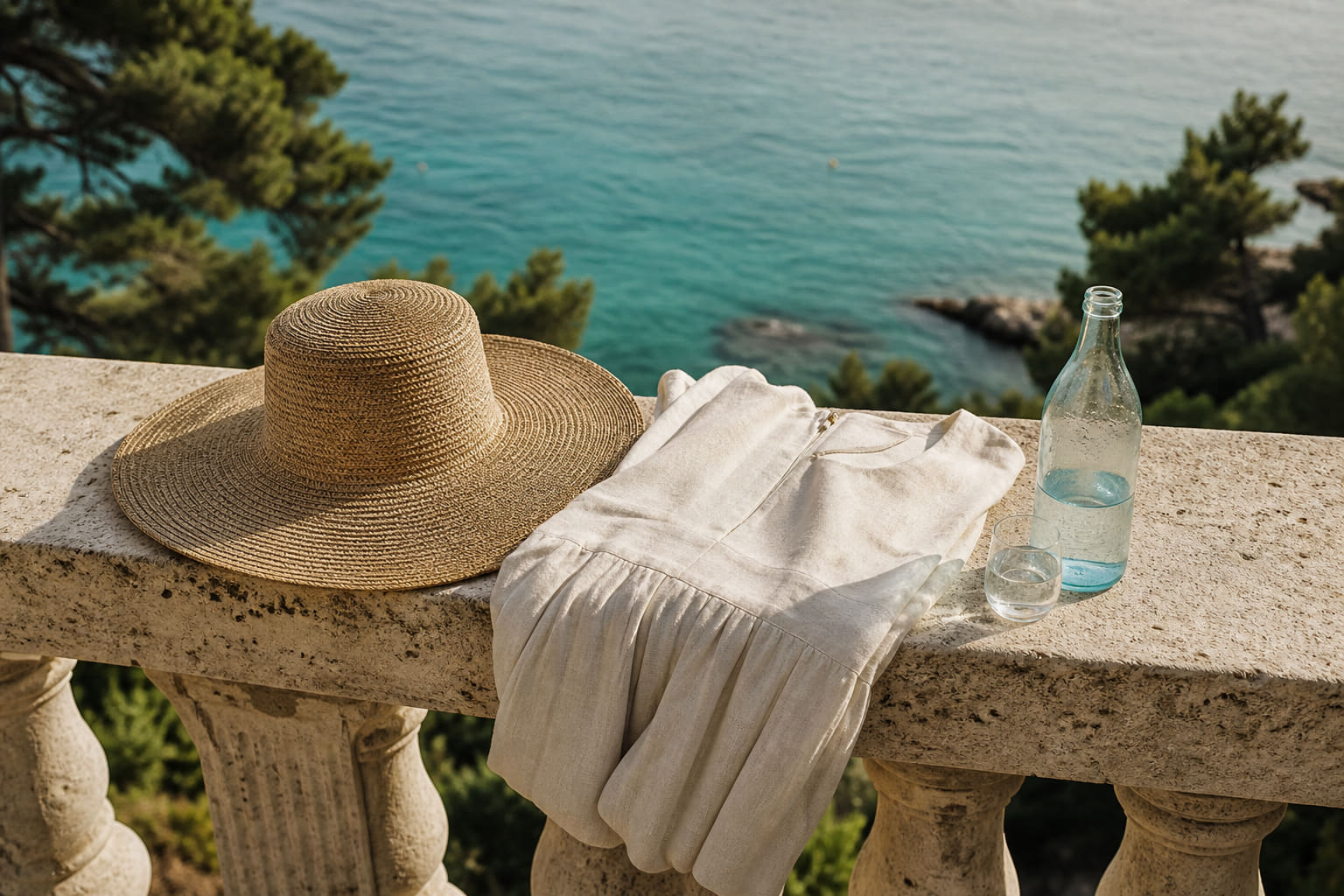
The French and Italian Rivieras share a particular quality of light, the kind that makes everything look slightly more beautiful than it did the moment before. That quality rewards clothes that are honest about their construction: real fabric, clean cut, considered proportion. It punishes anything that tries too hard.
Dressing for the Riviera is not about buying a new wardrobe before you board the plane. It is about understanding which silhouettes, which fabrics, and which colour temperatures actually belong in that landscape. A woman who arrives in Antibes or Portofino wearing the right dress does not look like she planned it. She looks like she lives there.
This guide covers the specific choices that produce that impression, from the fabrics that survive a full day of coastal heat with their structure intact, to the dress silhouettes that carry you from a harbour-side café at noon to a terrace dinner at nine without a single awkward moment.
Key takeaways
- Choose natural fabrics such as linen, cotton voile, and lightweight jacquard over synthetics; they breathe, drape, and photograph beautifully in Mediterranean heat.
- A maxi or midi silhouette in a solid or tonal print reads as the most polished choice for daytime on the Riviera, especially at lunch terraces and coastal towns.
- Reserve bold colour for accessories or a single accent piece; the Riviera palette is built on ivory, sage, terracotta, and soft navy.
- Lace details and broderie anglaise add texture without weight, making them ideal for warm evenings without the need for a separate layer.
- Pack one versatile strapless or strappy dress that moves from a beach lunch to a candlelit dinner with only a change of shoes and jewellery.
In this guide
- The Fabric Hierarchy: What the Heat Demands
- Silhouette by Setting: Matching the Cut to the Occasion
- The Riviera Colour Palette: Restraint as a Statement
- Day to Evening: The Dresses That Do Both
- Lace, Crochet, and Texture: The Details That Define Riviera Dressing
- The Final Edit: Building a Riviera Dress Wardrobe That Actually Travels
- Frequently asked questions
The Fabric Hierarchy: What the Heat Demands
Mediterranean summer heat is not the humid, enervating heat of the tropics. It is dry, bright, and often accompanied by a sea breeze. That distinction matters for fabric choice. Linen is the obvious answer, but it is only the beginning. Cotton voile, cotton lawn, lightweight jacquard, and open-weave cotton blends all perform well in this climate. They absorb moisture, release it quickly, and hold a shape that synthetic fibres simply cannot maintain once the temperature climbs past 30 degrees.
Polyester and viscose blends, however well they drape in an air-conditioned showroom, tend to cling and lose their silhouette by midday. The Riviera is not forgiving of that. If you are packing for a week in Cinque Terre or Cap d'Antibes, the resort dresses you choose should be examined for their fibre content before anything else.
Lace deserves its own mention. A dress with lace detailing, particularly hollow-out or broderie-style lace, functions as its own ventilation system. The open weave allows air to circulate while the texture reads as genuinely refined rather than casual. This is why lace has been a fixture of Mediterranean summer dressing for generations. As the history of lace on Wikipedia notes, European lace traditions originating in Italy and Flanders have long been associated with luxury textile production, a heritage that still carries cultural weight on the Riviera today.
- Best fabrics for daytime: linen, cotton lawn, cotton voile, open-weave crochet
- Best fabrics for evening: lightweight jacquard, cotton lace, fine cotton with structure
- Fabrics to avoid: heavy polyester, thick viscose, any fabric that does not breathe
Expert insightRun the fabric test before you pack: hold the dress up to a window. If light passes through it evenly, it will breathe. If it looks opaque and dense, leave it at home.

Silhouette by Setting: Matching the Cut to the Occasion
The Riviera is not one setting. It is a sequence of them, each with its own social register. A morning walk through the old port of Nice calls for something different from a long lunch at a cliffside restaurant in Eze, which calls for something different again from an aperitivo on a hotel terrace in Positano.
For daytime exploration, a midi or maxi length in a fluid fabric is the most consistently correct choice. It keeps the body cool, reads as polished rather than overdressed, and moves well on uneven cobblestones. The Elegant Santorini Strapless Dress is a strong example of this principle: a maxi silhouette with a clean strapless neckline that requires no jewellery to look complete. Pair it with flat leather sandals in the morning, block-heel mules in the evening.
For lunch at a terrace restaurant, a dress with some structure at the bodice, whether a defined waist seam, a tie detail, or a fitted top, signals that you dressed with intention. The Dreamy Retro Gentle Floral Dress achieves this with a soft floral print that reads as European rather than resort-casual, the kind of dress that looks correct beside a table set with white linen and good glassware.
For evening, a mini length becomes appropriate when the dress itself is refined in its construction. A lace mini or a structured cotton mini with careful seaming reads as chic rather than underdressed. For those who prefer length at night, a column-cut maxi in a single colour is the most sophisticated option on the Riviera. Consider the Dina Short-Sleeve Lace Dress for an evening look that has genuine substance: the short sleeve adds a note of propriety while the lace keeps it warm-weather appropriate.
For a more complete breakdown of how to build a Riviera packing list, the article on resort dresses and what to pack for a luxury holiday covers the full range of occasions.
Expert insightOne maxi, one midi, and one shorter dress covers almost every occasion on a week-long Riviera trip. The variation in length does more work than the variation in colour.

The Riviera Colour Palette: Restraint as a Statement
The colour palette of the Riviera is not the neon-bright palette of a beach holiday catalogue. It is the palette of the landscape itself: ivory, warm white, sage green, dusty terracotta, faded navy, and the particular blue of the sea on a clear afternoon. These colours work because they reflect rather than compete with the light.
A woman in a resort light green dress against a white-washed wall in Santorini or a terracotta-coloured facade in Menton looks like she belongs. The same woman in a saturated neon print looks like she is visiting. That is the distinction that matters.
White and ivory are the most versatile choices and the most forgiving in strong sunlight. The French Niche Style White Dress illustrates the principle well: white with considered detail reads as deliberate and refined, not blank. Similarly, the Kiara French White Lace Dress uses lace texture to give white depth without introducing colour.
Prints should be tonal or classic. A small floral, a fine stripe, a polka dot in a restrained scale, these all work. A large abstract print or a high-contrast graphic print tends to read as jarring in the Riviera context. The Marbella Puff Sleeve Polkadot Dress shows how a polka dot can be handled with enough refinement to feel genuinely Riviera rather than seaside novelty.
For more on building a summer wardrobe around this colour logic, the Spring Summer Old Money Woman collection reflects the same palette principles.
Expert insightIf you are uncertain about a print, hold it next to a photograph of the location you are visiting. If the colours clash with the architecture, reconsider.

Day to Evening: The Dresses That Do Both
The most practical thing you can bring to the Riviera is a dress that genuinely works across two occasions without requiring a full change. This is not about a dress being neutral to the point of invisibility. It is about a dress having enough structure and quality of detail that it reads correctly in different contexts depending on what you carry with it.
A strappy dress in a refined fabric is the clearest example. During the day, worn with flat sandals and a woven bag, it registers as relaxed but considered. In the evening, worn with heeled mules, a small leather bag, and a pair of good earrings, the same dress reads as dressed for dinner. The Amy Pink Dress Suspender operates on exactly this logic: the adjustable strap detail and fitted silhouette give it enough formality for evening without making it feel overdone at noon.
The Celia Long Dress with Ruffled Edges is another strong candidate for this dual role. The ruffled hem detail gives it movement and visual interest that suits both a breezy afternoon walk and a candlelit terrace. In a pale or neutral tone, it requires almost no styling to look complete.
For guidance on exactly this kind of occasion-bridging dressing, the article on dressing for high-end al fresco dinners in summer addresses the specific considerations of warm-weather evening dress in fine outdoor settings.
What makes a dress genuinely versatile on the Riviera: - A silhouette that is neither purely casual nor purely formal - A fabric with enough body to hold its shape through a long day - A neckline that does not require specific undergarments - A length that works with both flat and heeled shoes

Lace, Crochet, and Texture: The Details That Define Riviera Dressing
The Riviera has always had a particular relationship with artisanal textile detail. The French lace industry, centred historically around Calais and Alençon, and the Italian tradition of handmade crochet and embroidery, both feed into the visual vocabulary of this coastline. A dress with genuine lace or crochet construction carries that heritage without needing to announce it.
The Crochet Mini Dress Summer is a direct expression of this tradition: open-weave crochet in a clean silhouette that breathes in the heat and reads as crafted rather than mass-produced. Worn over a simple swimsuit during the day or over a slip at evening, it covers the full range of Riviera occasions.
For something with more coverage and formality, the Lace Patchwork Sweet Floral Dress combines lace with a floral element in a way that feels genuinely European rather than costume-like. The key is the proportion: the lace is used structurally, as a bodice or hem element, rather than as an all-over covering that reads as lingerie-adjacent.
Texture also functions as a temperature regulator. A dress with broderie anglaise eyelet detail, open lace panels, or crochet sections allows air to move against the skin. This is not incidental. It is the reason these textile traditions developed in warm Mediterranean climates in the first place, a point supported by the textile history of the Mediterranean region and its long association with fine open-weave fabrics.
For women building a broader summer wardrobe around these principles, the summer dresses collection brings together the silhouettes and details discussed here in a single place.

The Final Edit: Building a Riviera Dress Wardrobe That Actually Travels
A Riviera packing list should be edited the same way a good sentence is edited: remove everything that does not earn its place. For a week on the Mediterranean coast, three to five dresses cover every occasion if each one is chosen with genuine thought.
The structure of a strong Riviera dress wardrobe:
- One maxi or long midi in ivory or white for daytime exploration and long lunches. The minimalist long dress sleeveless round neck in a clean, unadorned silhouette is exactly this: nothing superfluous, everything correct.
- One floral or printed midi for colour and personality. The Lina Romantic Floral Dress brings the warmth of a traditional Mediterranean print without tipping into tourist-market territory.
- One lace or textured dress for evenings. See the options discussed in the previous section.
- One shorter dress in a solid colour for beach-adjacent days and casual movement between locations.
- Optionally, one striped piece as a nod to the coastal heritage of the region. The Blue Striped Dress Lovau Style handles this reference with enough refinement that it reads as considered rather than obvious.
All five of these can be worn with the same two pairs of shoes: a flat leather sandal and a low block-heel mule. They can be packed flat without significant wrinkling if the fabric is linen or cotton. And they each photograph well in the particular quality of Mediterranean light, which, when you are on the Riviera, matters more than you might expect.
For a deeper look at how this kind of considered summer dressing connects to the broader old money aesthetic, the article on best summer dresses for an old money look provides the full editorial context.

| Occasion | Best Silhouette | Fabric to Choose | Key Detail | Shoe Pairing |
|---|---|---|---|---|
| Morning coastal walk | Maxi or long midi | Linen, cotton voile | Clean neckline, minimal detail | Flat leather sandal |
| Terrace lunch | Midi with defined waist | Lightweight jacquard, cotton lawn | Tie waist or structured bodice | Low block-heel mule |
| Afternoon at the port | Crochet or lace mini | Open-weave cotton crochet | Artisanal texture, open weave | Flat woven sandal |
| Aperitivo on a hotel terrace | Strappy midi or column maxi | Cotton lace, fine cotton | Lace panel or broderie detail | Heeled mule or low heel |
| Candlelit dinner | Maxi column or structured mini | Lace, jacquard, or cotton with body | Single refined detail, clean seaming | Block heel or kitten heel |
Frequently asked questions
What is the best dress length to wear on the French or Italian Riviera?
A midi or maxi length works for almost every daytime occasion on the Riviera, from walking coastal paths to sitting at a restaurant terrace. It keeps you cool, looks polished, and moves well on uneven surfaces. For evenings, a shorter lace or structured dress is equally appropriate. The maxi dresses collection is a good starting point for finding the right length.
Can I wear white on the Riviera without it looking plain?
White is one of the strongest choices you can make for Mediterranean dressing. The key is texture: a white dress with lace detail, broderie anglaise, or a fine jacquard weave reads as genuinely refined rather than underdressed. A flat, unbroken white in a fabric with no surface interest can look blank, but that is a fabric problem, not a colour problem.
How do I dress for a Riviera dinner without being overdressed?
The Riviera dinner register is smarter than beach-casual but less formal than a city restaurant. A lace midi, a column maxi in a solid colour, or a strappy dress in a refined fabric with good shoes and simple jewellery is exactly right. Avoid anything with sequins or very heavy construction. For more specific guidance, the article on dressing for high-end al fresco dinners in summer covers this occasion in detail.
What colours work best for a Riviera holiday wardrobe?
Build around ivory, warm white, sage green, dusty terracotta, and soft navy. These colours reflect the landscape and the architecture of the region and work well together, which means you can pack fewer pieces and still have multiple outfit combinations. A single printed dress with a tonal floral or classic stripe adds personality without disrupting the palette.
The Riviera rewards a particular kind of dressing: specific, honest about its materials, and confident enough to require no embellishment. The women who look most at home on that coastline are not the ones who packed the most. They are the ones who understood that a well-chosen resort dress in the right fabric does more work than an entire suitcase of alternatives. Pack with that principle and the rest follows naturally.