


How to Keep White Shirts Brilliant White Without Bleach
Reading time 12 min • 2430 words
A white shirt is the most exacting garment in a man's wardrobe. It tolerates no shortcuts. The collar must sit crisp and clean, the body must hold its brightness wash after wash, and the fabric must not thin or yellow before its time. Most men reach for chlorine bleach the moment they notice any dullness, which is the single worst thing you can do to a fine shirt.
Chlorine bleach is aggressive. On cotton and linen it breaks down the cellulose fibres that give the cloth its body and sheen. Over several washes it leaves the fabric weaker, thinner, and paradoxically more prone to the yellow cast it was supposed to remove. On any shirt containing a synthetic blend it can cause irreversible discolouration within a single cycle.
There is a better way, and it does not require expensive products. What it requires is understanding why white shirts go dull in the first place, and applying the correct counter-measure at each stage of the wash. The methods below work on every fabric you will find in a quality white shirt, from tightly woven cotton poplin to open-weave linen, and they extend the life of the garment considerably.
Key takeaways
- Chlorine bleach weakens cotton and linen fibres over time and causes the yellow cast it is supposed to prevent.
- An oxygen-based brightener soak before washing restores whiteness without degrading fabric structure.
- Cold or 30°C washes preserve fibre integrity; reserve 40°C for heavily soiled items only.
- Drying white shirts in direct sunlight for 20 to 30 minutes acts as a natural brightener at no cost.
- Hard water and deodorant residue are the two most common causes of yellowing, and both are preventable.
In this guide
Why White Shirts Yellow: The Real Causes
Before you can fix the problem you need to understand it. White shirts do not yellow randomly. There are three consistent culprits.
Aluminium-based antiperspirant residue is the most common cause of underarm yellowing. Aluminium salts in antiperspirant react with the protein in sweat and bind to cotton fibres, creating a compound that turns yellow with heat, particularly in the dryer. Switching to a deodorant without aluminium, or at minimum applying it and allowing it to dry fully before dressing, makes a measurable difference.
Hard water mineral deposits leave calcium and magnesium salts in the fabric after each wash. These salts scatter light and give white cloth a grey or dingy appearance. If your tap water is hard, this is likely the primary reason your shirts look dull even after washing.
Heat from the dryer sets stains and accelerates the breakdown of optical brighteners in the fabric. The high-temperature tumble dry that feels efficient is actually locking in any residue that the wash did not fully remove.
Understanding these causes directs you toward the right solutions: targeted pre-treatment, water softening, and lower-temperature drying. If you are also dealing with care questions around other light-coloured garments, the article on keeping white polos looking brand new covers similar ground for knit fabrics.
Expert insightApply antiperspirant the evening before and allow it to dry overnight. By morning the aluminium salts have fully bonded to your skin rather than your shirt, which eliminates the primary cause of collar and underarm yellowing.
The Oxygen Soak: Your Most Effective Tool
Oxygen-based brighteners, sold under names such as sodium percarbonate, are the correct alternative to chlorine bleach. When dissolved in warm water they release hydrogen peroxide slowly, which breaks down organic stains and restores the optical brightness of white fibres without attacking the cellulose structure of cotton or linen.
The method is straightforward. Fill a basin or sink with water at approximately 40°C. Add one to two tablespoons of sodium percarbonate powder and stir until dissolved. Submerge the shirt completely and leave it for one to four hours, depending on the degree of dullness. For heavily yellowed collars, a full overnight soak causes no harm to well-constructed shirts.
After soaking, transfer directly to the washing machine and run a normal cold or 30°C cycle. Do not rinse the shirt separately first; the residual solution continues working in the machine drum.
This method is safe for the fine white linen shirts that form the backbone of a warm-weather wardrobe, as well as for cotton poplin and the lyocell-linen blends used in more relaxed summer shirting. For linen specifically, how to care for linen clothing in summer is worth reading alongside this guide.
One important note: always check the care label. A shirt labelled hand-wash only should be soaked and gently pressed rather than machine-washed, regardless of fabric.
Expert insightSodium percarbonate is most effective between 40°C and 60°C. For delicate fabrics, dissolve it in hot water first, then add cold water to bring the soak temperature down before submerging the shirt.
Washing Temperature, Detergent, and Load Discipline
The washing machine settings you choose matter as much as the products you use.
Temperature: 30°C is sufficient for lightly worn white shirts and preserves fibre integrity over the long term. Reserve 40°C for shirts with visible staining or heavy collar soil. Never wash white linen or fine cotton at 60°C routinely; the fibres contract and the weave begins to distort after several cycles at that temperature.
Detergent: Use a detergent formulated for whites. These contain optical brightening agents, compounds that absorb ultraviolet light and re-emit it as visible blue light, which counteracts the yellow cast the eye reads as dinginess. Use the correct dosage, not more. Excess detergent leaves a residue in the fabric that attracts dirt and contributes to dullness.
Load discipline: Wash white shirts separately from any coloured garments, including pale blue or grey items. Colour transfer in a cool wash is subtle but cumulative. After six to twelve washes with mixed colours, a white shirt will carry a faint grey undertone that no amount of re-washing will fully remove.
Fabric softener: Avoid it entirely on white shirts. Fabric softener coats fibres with a waxy film that reduces absorbency and, over time, traps body oils and detergent residue, which accelerates yellowing. A tablespoon of white distilled vinegar added to the fabric softener drawer achieves a similar softening effect without the residue.
For a well-constructed shirt that rewards this level of care, the Milano linen cotton white shirt is a useful reference point. Its linen-cotton blend responds well to cool washes and retains its weave structure across many cycles.

Collar and Cuff Pre-Treatment
The collar and cuffs of a white shirt accumulate a combination of skin oils, dead cells, and product residue that a standard machine wash does not fully address without pre-treatment.
The paste method: Mix one part liquid dish soap with one part hydrogen peroxide (3% pharmacy grade) and apply it directly to the soiled area with a soft brush or old toothbrush. Work it gently into the fabric and leave for 20 to 30 minutes before washing. This combination cuts through body oils effectively and does not damage the weave of fine cotton or linen.
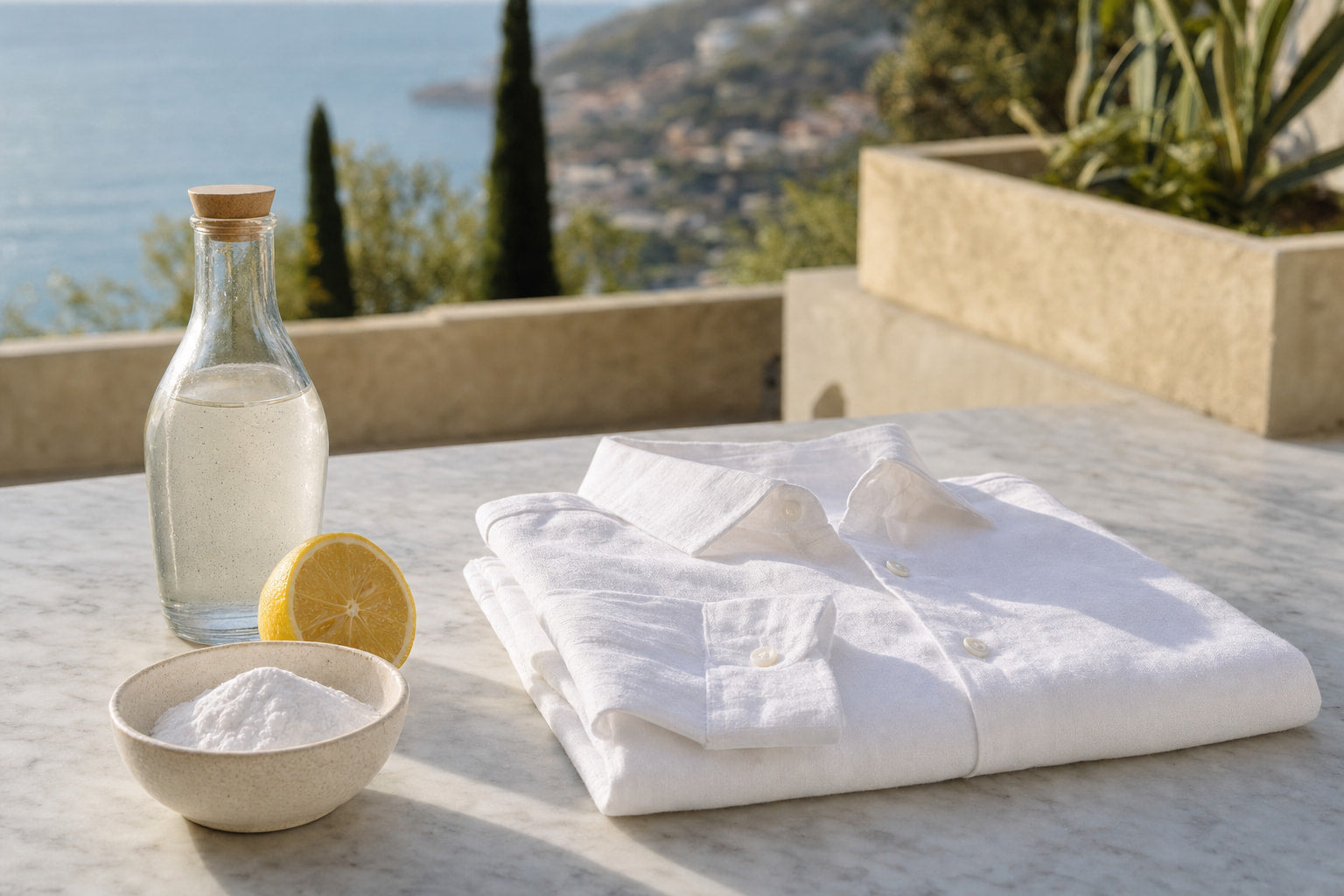
Baking soda paste: For a milder option, mix baking soda with a small amount of water to form a thick paste. Apply to the collar, leave for 30 minutes, and brush off before washing. This works well on light yellowing and is completely safe for all white shirt fabrics including the delicate weaves found in formal dress shirts.
For shirts with structured collars, maintaining the shape during and after washing is equally important. The article on collar stays addresses how to preserve that crispness after care.
A word on collar construction: shirts with a fused interlining in the collar, common in lower price-point garments, are more vulnerable to delamination if soaked repeatedly. High-quality shirts with a sewn-through or floating interlining tolerate pre-treatment far better, which is one reason construction quality directly affects how well a shirt ages.
Expert insightTurn the shirt inside out before machine washing. The collar and cuff seams take the most mechanical abrasion in the drum, and inside-out washing concentrates that friction on the interior surface rather than the visible outer face of the fabric.

Drying: Where Most Men Get It Wrong
Drying is where the effort of a careful wash is most often undone.
The tumble dryer is the enemy of white shirts for two reasons. First, the heat sets any residual staining that the wash did not fully remove. Second, repeated high-heat cycles cause the optical brightening agents in the fabric to degrade faster, which is why a shirt that looked sharp when new begins to look dingy after a year of regular machine drying.
Line drying in sunlight is the correct method. UV light acts as a natural bleaching agent on white cellulose fibres, a process well-documented in textile science. Twenty to forty minutes of direct sun exposure after washing is enough to brighten white cotton or linen noticeably. This is why shirts dried outside consistently look whiter than those dried indoors or in a machine.
If outdoor drying is not practical, dry the shirt on a hanger in a well-ventilated room and allow it to dry fully before pressing. A shirt pressed while damp but not fully dried retains moisture at the seams and collar, which encourages the mild mildew that contributes to off-white discolouration over time.
Ironing temperature matters too. Iron white linen at a high setting with steam; the heat and moisture help reset the fibres and the shirt comes out looking visibly crisper. Cotton poplin responds well to a medium-high iron on the reverse side first, then the front. Both fabrics should be ironed while still slightly damp from drying for the best result.
If you invest in a white linen shirt built for summer, correct drying and pressing are what keep it looking sharp through an entire season rather than just the first few wears.

Long-Term Storage and Seasonal Maintenance
Keeping a white shirt brilliant white is not only a laundry question. How you store it between wears and between seasons has a significant effect on its long-term appearance.
Never store a white shirt unwashed. Body oils left in the fabric oxidise over weeks and months, and the resulting stains are set deep in the fibre by the time you retrieve the shirt. A shirt worn for even a few hours should be washed before storage.
Avoid plastic dry-cleaning bags for long-term storage. Plastic traps moisture and, in some cases, releases chemicals that react with white fibres and cause yellowing. Use a breathable cotton garment bag or simply hang the shirt in open wardrobe space.
Acid-free tissue paper folded inside the shirt when it is stored flat prevents crease lines from setting permanently into the fabric, which is particularly relevant for fine linen shirts where crease marks in storage can become permanent after several months.
For men who keep a considered wardrobe of white and off-white pieces, it is worth reading the piece on off-white in a refined wardrobe for a broader perspective on how to maintain this colour family across multiple garments.
The linen shirts collection at Lovau covers the range of white and off-white shirting that benefits most from these care practices. These are shirts built with fabric quality that rewards the effort. A fine Paris linen shirt or a contemporary white linen shirt maintained correctly will look as good in its fourth season as it did in its first.

| Method | Effectiveness | Safe for Linen | Safe for Fine Cotton | Ease of Use |
|---|---|---|---|---|
| Chlorine bleach | High short-term, degrades fabric fast | No | No | Easy but destructive |
| Oxygen brightener soak | High, sustained over many washes | Yes | Yes | Moderate |
| Sunlight drying (UV) | Moderate, cumulative | Yes | Yes | Very easy |
| Hydrogen peroxide paste (3%) | High for collars and cuffs | Yes | Yes | Moderate |
| Baking soda paste | Low to moderate | Yes | Yes | Very easy |
| White distilled vinegar rinse | Low, removes residue only | Yes | Yes | Very easy |
Frequently asked questions
Can I use bleach on a white linen shirt if I dilute it heavily?
No. Even diluted chlorine bleach attacks the cellulose structure of linen fibres. The damage is cumulative and becomes visible as thinning, pilling, and a permanent yellow cast after several washes. Use an oxygen-based brightener instead. It achieves the same whitening result without weakening the weave.
How often should I do an oxygen soak on a white shirt?
Once every four to six washes is sufficient for maintenance. If a shirt has become noticeably dull or yellowed, a single overnight soak followed by a normal wash cycle will usually restore it. For shirts worn frequently in summer, a monthly soak keeps them consistently bright without over-treating the fabric.
Why does my white shirt still look yellow after washing?
The most likely cause is either antiperspirant residue that has been set by dryer heat, or hard water mineral deposits building up in the fibres over multiple washes. Pre-treat the collar and underarm areas with a hydrogen peroxide paste, add a tablespoon of citric acid to the wash drum to counteract mineral deposits, and dry the shirt in direct sunlight rather than the machine. If you are seeing this pattern across multiple garments, also read the guide on keeping white shirts looking sharp through summer for additional context.
Is it safe to use these methods on an off-white or ecru shirt?
Use caution. Oxygen brightener soaks and sunlight drying both push fabric toward a cooler, brighter white. On a shirt that was intentionally woven in a warm ecru or off-white tone, repeated brightening treatments will alter the colour. For off-white shirts, stick to a cool machine wash with a gentle detergent and avoid direct sunlight drying beyond 10 to 15 minutes.
A white shirt kept in genuine condition is a statement of care and attention that no amount of styling can substitute. The methods here are not complicated but they require consistency: pre-treat the collar, soak with oxygen brightener when needed, wash cool, and dry in the light. Do that across the life of the shirt and it will hold its brilliance through years of wear. If you are building or refining the white shirt side of your wardrobe, the full range of men's linen and cotton shirts at Lovau is the right place to start.