


Aviator vs Square Sunglasses: Which Suits You Best?
Reading time 14 min • 2740 words
Two frames dominate the conversation in refined men's eyewear: the aviator and the square. Both have genuine heritage, both photograph well, and both appear constantly on men whose style reads as considered rather than trend-chasing. The problem is that they do very different things to a face, and choosing the wrong one is not a disaster but it is a missed opportunity.
This is not about which style is more fashionable right now. Fashion cycles are irrelevant to a man who buys with intention. The question is which frame geometry complements your face, fits the occasions you actually dress for, and holds up alongside the rest of your wardrobe. The answer depends on three things: face shape, lens colour, and how you plan to wear them.
Below, we work through both frames in honest detail, including which face types they serve, how to pair them with summer linen or a silk polo, and where each style sits on the formality register. By the end, you will know exactly which direction to go.
Key takeaways
- Aviators suit oval, oblong and heart-shaped faces; their curved lens softens angular bone structure.
- Square frames balance round or oval faces by adding definition and visual width to the jaw area.
- Lens tint matters as much as frame shape: gray gradient reads formal, amber or orange reads resort.
- Tortoiseshell and black acetate frames both work with a linen shirt or a knit polo without looking costume-y.
- Neither frame is inherently casual or formal; the metal finish and lens colour determine the register.
In this guide
- The Aviator: History, Geometry and Who It Actually Flatters
- The Square Frame: Structure, Confidence and the Faces That Wear It Best
- Face Shape, Frame Shape: The Practical Guide
- Occasion and Outfit Pairing: When to Reach for Which Frame
- Lens Colour, Tint and What It Communicates
- Building a Two-Frame Wardrobe: The Case for Owning Both
- Frequently asked questions
The Aviator: History, Geometry and Who It Actually Flatters
The aviator frame was developed in the 1930s for military pilots who needed maximum peripheral vision and glare reduction at altitude. The defining characteristic is the teardrop lens, wider at the top and tapering toward the bottom, paired with a thin metal bridge and fine temples. That geometry has not changed meaningfully in ninety years, which is exactly why it still looks right.
Because the lens is taller than it is wide, the aviator introduces vertical length to the face. This makes it particularly effective on men with round or oval faces, where the extra visual height elongates proportions that might otherwise read as soft. It also works well on heart-shaped faces, where the wider upper lens echoes the broader forehead and the taper mirrors the jaw.
On a man with an already long or oblong face, a tall teardrop lens can push the vertical proportion further than is flattering. In that case, the aviator still works but you want a frame with a slightly lower lens height and a wider bridge spread.
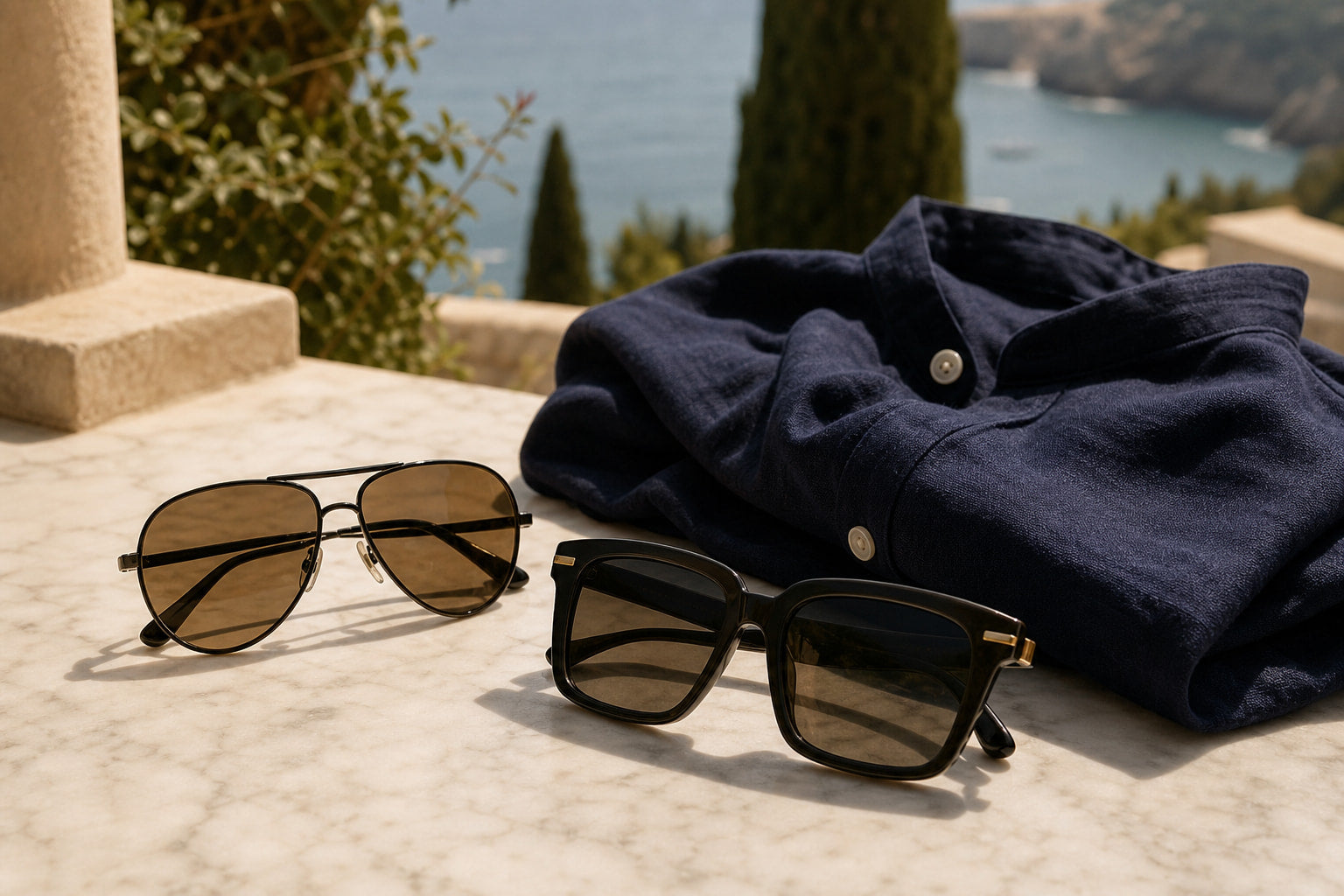
For tint, the classic choice is gray or a light amber. The Black Aviator Light Orange Lense Sunglasses, Limited Edition takes the traditional silhouette and introduces a warm amber-orange lens that reads as resort without being loud. It pairs cleanly with a high count fine white linen shirt and double-pleated trousers for a Riviera afternoon. The Blue Light Orange Sunglasses, Limited Edition offers the same warm lens energy in a blue acetate frame, a combination that sits confidently against navy or ivory.
Metal frames, particularly in gold or silver, keep the aviator in its most formal register. Acetate or matte black push it toward weekend and travel. Both are correct; the context decides.
Expert insightA thin double-bridge aviator reads more European and less utilitarian than a single bridge. If you want the frame to feel dressed rather than sporty, look for that double-bar detail.

The Square Frame: Structure, Confidence and the Faces That Wear It Best
The square or rectangular frame is the architectural counterpart to the aviator's curve. Where the aviator softens and elongates, the square frame adds definition and horizontal weight. The lens sits flat across the top and bottom, the corners are sharp or gently rounded, and the overall effect is one of deliberate structure.
This geometry works best on men with round, oval or softer facial features, where the straight lines of the frame introduce contrast and make the face read as more defined. A round-faced man in a square frame gains apparent cheekbone structure. An oval-faced man can carry almost any square frame without adjustment.
On a man with a strongly square jaw and angular cheekbones, a square frame can amplify the geometry to the point of looking severe. In that case, look for a square frame with slightly rounded corners, or choose a frame that is rectangular rather than perfectly square, which softens the effect while keeping the structural read.
The Black Square High-End Sunglasses with Gold Accents is the most formal expression of this category: black acetate, gold hardware, clean proportions. It belongs on a man in a high-end acetate mulberry silk blend polo at a hotel terrace or a summer gallery opening. The Milano Black Square Sunglasses, Gray Gradient Tint is marginally more relaxed, the gradient lens reducing intensity without losing the frame's authority.
For a warmer, earthier palette, the Amber Brown Geometric Rectangular Sunglasses translates the square silhouette into tortoiseshell-adjacent amber tones that work particularly well with tan linen, olive cotton or a French retro striped knit polo.
Square frames also photograph better against architectural backgrounds, which is relevant if you care about the visual coherence of your wardrobe in practice.
Expert insightThe width of a square frame should not exceed the widest point of your face. A frame that extends beyond the temples looks borrowed rather than chosen.

Face Shape, Frame Shape: The Practical Guide
Most style advice on face shapes is too rigid. The reality is that the same man can wear both an aviator and a square frame depending on proportions and lens size. The guidelines below are starting points, not rules.
Oval face: The most versatile face shape. Both aviator and square frames work. Choose based on occasion and outfit rather than face geometry.
Round face: Square and rectangular frames are the stronger choice. They add the horizontal definition that a round face lacks. A teardrop aviator can also work if the lens is wide rather than tall.
Oblong or rectangular face: Wider frames in either category help. A square frame with a wide bridge spread balances a long face better than a narrow aviator. Look for frames where the lens width is at least as wide as your cheekbones.
Heart-shaped face: The aviator's wider upper lens mirrors the forehead naturally. Square frames with a lighter frame weight, thin acetate rather than thick, also work well by not adding visual bulk to an already prominent upper face.
Square jaw: Slightly rounded square frames or a classic oval aviator soften the geometry. A perfectly square frame on a square jaw creates a doubling effect that looks unintentional.
For men exploring the full range of men's sunglasses before committing, it helps to try frames in person or to photograph yourself in each shape. The mirror in a shop is rarely the same as how you actually look in daylight.
The Tortoiseshell Light Blue Sunglasses sit in an interesting middle category: a tortoiseshell frame with a softer lens shape that reads as neither strictly aviator nor strictly square. It is a useful option for men who find both extremes too committal.

Occasion and Outfit Pairing: When to Reach for Which Frame
Frame shape does not determine formality in isolation. The material, finish and lens colour all contribute. That said, the two styles do pull in slightly different directions by default.
Aviators read as more relaxed and continental. A black metal aviator with an amber lens belongs on a man at a coastal lunch, on a boat, or traveling through a southern European city in July. The silhouette has an inherent ease that pairs naturally with linen. Worn with a Marbella square collar linen shirt and double pleated linen shorts, a well-chosen aviator completes an outfit that reads as intentionally underdressed in the best possible sense.
Square frames carry more visual weight and tend to read as more deliberate. A black acetate square frame with gold hardware, like the Black Square High-End Sunglasses with Gold Accents, can accompany a tailored linen trouser and a high count navy blue fine linen shirt to a smart-casual event without looking out of place. The same frame worn with a polo and shorts still works; it simply reads as a more considered choice.
For travel specifically, gray tint lenses are the most practical across different light conditions. The Milano Black Square Sunglasses, Gray Gradient Tint handles full Mediterranean sun without turning everything too dark indoors, which is the practical problem with very dark solid lenses.
If you are building a complete elegant outfit for a summer occasion, sunglasses are a final detail that either confirms the register or breaks it. A pair that is too casual against a dressed outfit, or too formal against a relaxed one, creates a visual inconsistency that is hard to name but easy to notice.
The old money aesthetic is built on this kind of consistency: every element reads from the same vocabulary. Sunglasses are not exempt from that logic.
Expert insightIf you own one pair of sunglasses and want it to work across every context from a city walk to a beach lunch, choose a black or tortoiseshell frame in a mid-size proportion with a gray or light amber lens. It will not be the most interesting choice, but it will never be wrong.

Lens Colour, Tint and What It Communicates
The frame shape gets the attention, but the lens colour determines the emotional register of the pair. This is underappreciated.
Gray and gray gradient lenses are the most neutral and the most versatile. They reduce brightness without distorting colour perception, which is why they are the default for driving and urban wear. On a square frame they read as serious; on an aviator they read as classic.
Amber and light orange lenses warm the visual field and have a distinctly resort quality. They communicate leisure, which is appropriate in context. The Black Aviator Light Orange Lense Sunglasses, Limited Edition uses this tint to shift a traditional aviator toward something more expressive without becoming costume-y.
Green lenses have a long heritage in quality eyewear, historically associated with Bausch & Lomb's original G-15 lens, which was designed to transmit colour as close to natural as possible. The Lovau Iconic Green Sunglasses, Limited Edition uses this tonal territory with a frame that sits between rectangular and geometric.
Blue tint lenses, particularly in a light shade, read as fashion-forward but can look dated quickly. The Hero Light Blue Sunglasses, Limited Edition handles this by keeping the frame itself restrained, which prevents the lens colour from becoming the whole point.
Rose tint lenses are the most editorial choice in this range. They work in resort contexts and in evening light. The Black Rose Tint Sunglasses keeps the frame simple so the lens does the work without the overall pair looking theatrical.
As a general principle, the bolder the lens colour, the more restrained the frame should be. The reverse is also true: a statement frame, thick tortoiseshell or strong gold hardware, reads better with a neutral lens.

Building a Two-Frame Wardrobe: The Case for Owning Both
The most considered approach is not to choose one frame style permanently but to own one of each and reach for the right one based on context. This is not extravagance; it is the same logic that leads a man to own both a white shirt and a navy shirt.
A practical two-frame wardrobe for a man who dresses with intention might look like this: one black metal or acetate aviator with a neutral lens for travel and coastal settings, and one square or rectangular frame in black or tortoiseshell with a gray or amber lens for more structured occasions and city wear.
The Retro Black Amber Rectangular Sunglasses occupies a useful middle position, a rectangular frame that reads as slightly retro without being nostalgic, with an amber lens that works in strong sun. Paired alongside an aviator, it covers a wide range of contexts without redundancy.
For men building out a broader summer wardrobe, the Man Spring Summer Old Money collection provides the clothing context in which these frames will actually live. Sunglasses chosen in isolation from the rest of the wardrobe are sunglasses chosen poorly.
If you are approaching this from the angle of top spring outfit ideas, eyewear is the detail that ties the palette together. A tortoiseshell frame against a tan linen shirt and a cream trouser is a complete colour story. A black square frame against a navy shirt is a different but equally complete one.

| Attribute | Aviator | Square / Rectangular |
|---|---|---|
| Lens shape | Teardrop, taller than wide | Flat-edged, wider than tall |
| Best face shapes | Round, oval, heart | Oval, oblong, round |
| Visual effect on face | Adds vertical length, softens angles | Adds horizontal definition, sharpens features |
| Default formality | Relaxed, continental | Structured, deliberate |
| Ideal occasions | Coastal, travel, outdoor lunch | City, smart-casual events, terrace dining |
| Frame material options | Metal most common, acetate available | Acetate most common, metal available |
Frequently asked questions
Can a man with a square jaw wear square sunglasses?
Yes, but the frame choice matters. A perfectly square frame on a strongly square jaw doubles the geometry and can look unintentional. Choose a rectangular frame, which is wider than it is tall, or a square frame with gently rounded corners. The Amber Brown Geometric Rectangular Sunglasses is a good example of a frame that reads as square without being rigidly so.
Are aviator sunglasses still considered timeless or are they dated?
Aviators are genuinely timeless in the same way a white Oxford shirt is timeless: they have been worn by well-dressed men for nearly ninety years and will continue to be. The risk of looking dated comes from choosing an aviator that is too large, too mirrored, or too associated with a specific trend moment. A clean, mid-size black or gold metal aviator with a gray or amber lens has no expiry date.
What is the difference between square and rectangular sunglasses?
Square frames have roughly equal height and width, creating a bold, symmetrical look. Rectangular frames are noticeably wider than they are tall, which produces a more horizontal, elongating effect. Rectangular frames are generally more flattering on a wider range of face shapes because they do not add height and width simultaneously. The Milano Black Square Sunglasses, Gray Gradient Tint sits at the squarer end; the Retro Black Amber Rectangular Sunglasses sits at the rectangular end.
How do I pair sunglasses with a linen outfit without looking too casual?
The frame finish does the work. A black acetate or metal frame with a neutral lens reads as considered even in a fully casual linen outfit. Avoid overly sporty details like thick rubber temple grips or mirrored lenses, which push the register toward athletic. A square frame with gold accents alongside a high count fine light blue linen shirt and tailored trousers reads as resort-smart rather than beach-casual.
Aviator or square, the frame you choose should do something useful for your face and read consistently with the rest of what you wear. The aviator elongates and softens; the square defines and structures. Neither is universally superior. A man with a round face and a relaxed summer wardrobe will likely reach for a square frame most often. A man with sharper features and a preference for coastal dressing will find the aviator more natural. If you are still deciding, browse the full men's sunglasses collection and consider both in the context of what you already own, because the right pair is the one that completes a wardrobe, not the one that arrives without a home.